








GUEST OPINION
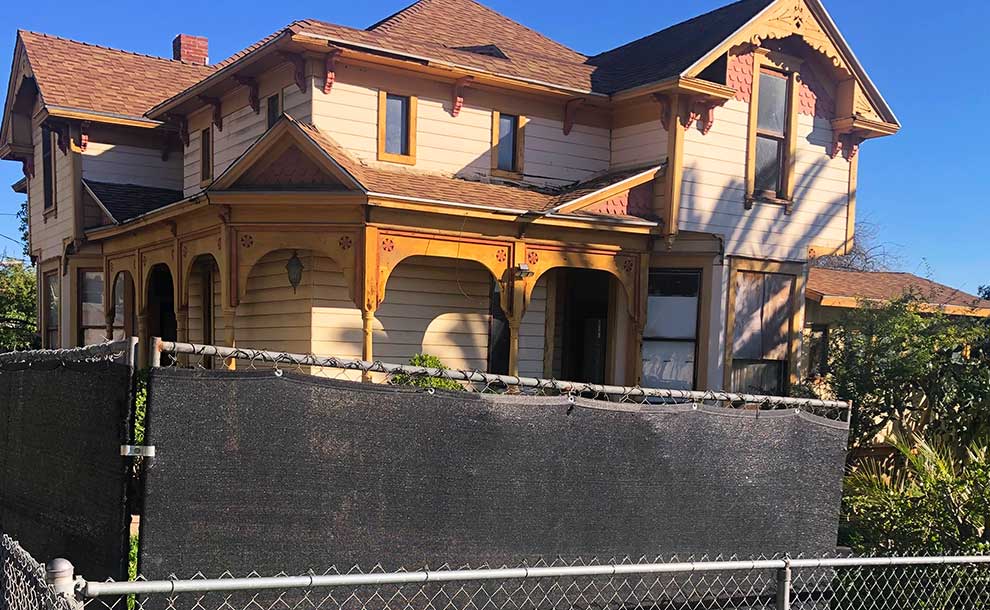
The 2-story Victorian-style house (Photo – Philip Tiffany)
In early 2025, the City of Monrovia made an unconventional move by purchasing an historic Victorian house and surrounding land at 222 East Cypress.
By Philip Tiffany and Fred Wasson
At a purchase price of $1,530,000, the 0.75-acres of unimproved residential land and a 2-story Victorian-style house was a bargain, perhaps 60% of its current market value. This $1.5 million acquisition, funded through Measure K sales tax dollars, presents a unique opportunity to both preserve an important piece of Monrovia’s history and address the City’s pressing affordable housing needs.
The City now faces two critical decisions: 1) what is the best way to restore and preserve this historic house built in 1892; and 2) how should this vacant residential land be utilized?
In our view, the City can best achieve its goals by:
- Selling the house, either at minimal or no cost, to a developer specializing in historic renovations, and
- Selling the land to an experienced housing developer through an RFP (Request for Proposal) process.
One developer is a local group that has demonstrated both an expertise in old home restoration and the means to complete the project to the City’s satisfaction. Their plan would involve moving the house to another lot within Monrovia at the developer’s expense. Currently in very substantial disrepair, this would guarantee the home’s revitalization and future use in alignment with Monrovia’s commitment to historic preservation.
The City could then set broad parameters and invite qualified residential development firms to compete for the development of the remaining 32,500 square feet of unimproved land through an RFP process. The City could: 1) evaluate the best proposal and developer, 2) sell the unimproved land to the winning bidder for the same $1,530,000 purchase price, and 3) ensure that quality and affordability goals are met through deed restrictions that transfer with the land.
The City’s affordable housing goals could be met with either rental apartments or owned homes. Recent years have seen an overwhelming number of new apartment developments, leaving a gap in affordable for-sale housing units. One solution could be to develop a bungalow court with at least 10 for-sale housing units on the site. Deed restrictions could prevent “quick flips,” allowing young families, likely to have school-aged children, to move into the City and purchase a home.
Given the ‘bargain’ price originally paid for 222 East Cypress, the savings could be passed on to the residential developer. This allows the City to recoup its original $1.5 million investment and enables the developer to offer for-sale housing at affordable prices for young families.
The alternatives are fraught with risks. The City 1) could lose money on its initial purchase, 2) make some development decisions for which it does not have the expertise, and/or 3) allow a development that poorly fits the neighborhood in terms of type, design, density, and quality. This is the City Council’s opportunity to make the right decision and prove the validity of its creative but non-traditional action.
Philip Tiffany is a retired retail executive with extensive experience in asset protection and consumer finance. He and his wife have called Monrovia home for 43 years.
Fred Wasson is a retired commercial real estate developer and investment manager who now volunteers his time to assist local non-profits with accounting, financial, and real estate matters.

Side of the historic house (Photo – Philip Tiffany)

(Photo – Philip Tiffany)












Leave a Reply