





Mariko Kitikubo and Kathabela Wilson soak in the View of Mt Fuji from Hakone, Japan.
A unique interview with Tokyo poet, Mariko Kitakubo, a passionate poet, a musical artist, and a frequent visitor to the Pasadena area.
Mariko brings us the gift of tanka, this wonderful short form of poetry, originally in the natural rhythms of the Japanese language, from 1400 years ago, to other languages and cultures. She performs, accompanying herself on percussion instruments, with natural dramatic and expressive fervor.
By Kathabela Wilson
A microscope on the poet

Mariko Kitikubo at Storierr Stearns garden in Pasadena.
The rhythm of your life, your breath, your pulse is tanka, what feelings touched your heart in your childhood that set the stage for your richly emotional poetic life?
loving you
who made
rainbows
on the bubbles
of my lifeHe looked at me, the father I admired when I was eight years old, and said “will you be alright if I go away?” I wanted to please him. I said “yes”. I was very sad, I could not tell him. Then he disappeared from my life forever. I could not describe it to myself, growing up, but I noticed that but there was a lot of “magma” inside of me… like layers…. for about 30 or 40 years.
like a cloud
vanishing like a ripple
that morning
my father
silently disappeared
A telescope on the poet
 What was your life like at home after your father left, what rhythms appeared in your life then?

There was a big difference between home and school, which made things complicated for me! At home I was the only child in a big family… after father left in the Japanese style house and cottages on the land we lived on were me, my grandma, my mother, 4 uncles and 4 aunts. I had to be a quiet, polite child. I couldn’t say ”I miss my father.’ Mother was so gentle, quiet and correct. She was a tea ceremony teacher. When we came back from somewhere, she often said and advised me “why did you say that? That was not a good thing for Mr. or Mrs. so and so. So please never say that again.” Her voice so soft and beautiful…. I should be sweet and smiling, I thought. I felt it better for everybody if I was quiet. Then also there was my very special grandma! She hummed the rhythms of “waka” the old form of tanka. She would say “this is my waka for today”… I think this was a beautiful soothing influence of tanka in my life. She was my influence. At school, my life was very different. I had to be a “contemporary child”. I could be very active and expressive, and all this built up a tension inside me, these two ways of being.
Pulse of the poet
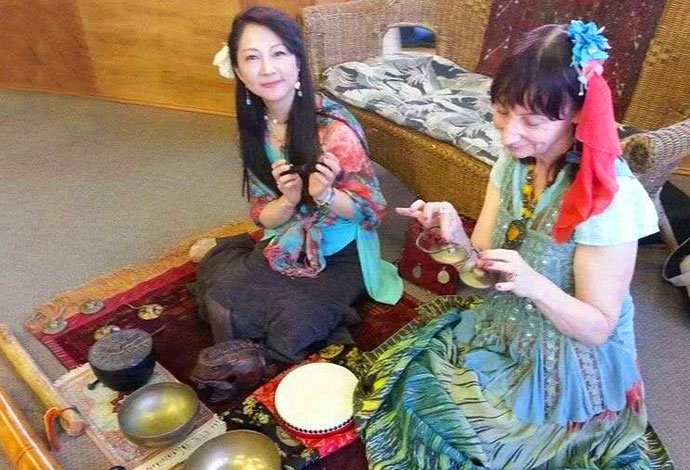
Mariko Kitikubo and Kathabela Wilson perform at Don Baird Studio Haiku reading.
How did tanka begin in your own voice?
When my mother died I realized that tanka could help me to lift the seal of the mountaintop of my life. Sitting next to my mother in the hospital, during her last weeks in 2003, I wrote, and wrote, to keep myself whole. Oh, my dearest beautiful so brilliant lady! Yes, My mother gave me The Last Biggest Present as my turning point!! I began a whole new life, thanks to her!
Compass on the poet

Mariko Kitikubo at Descanso Gardens.
What was the life she gave you, how did your life change?
As I said, Tanka helped to lift the seal from the mountaintop of my life! I could express my emotions in tanka, and I made so many wonderful friends worldwide. I began performing in 2005, and now I have done almost 80 performances in the U.S., Canada, Australia, France, and soon in Switzerland. Performance brings me one opportunity after another. I am such a fortunate poet.
At my first performance in Canberra, Australia in 2005, someone in the audience said “How beautiful this is! Like music!” I was reading my Japanese tanka, in the Japanese rhythms. So I realized that I should introduce Japanese original sounds overseas more.
Now I perform in Japanese and English, even write some of my tanka directly in English. I hope I can continue performing tanka even someday when I can’t walk… like planting sunflower seeds.
tanka seeds
like planting
sunflowers
dreaming … around the world
100 years later


Mariko Kitakubo brush painting and tanka.
While reading below, listen to Mariko reading her tanka with some of her own percussion, with Rick Wilson accompanying her on shakuhachi.
1
死火山に見えたりしわが休火山 火口得たるや幽かに呻く
looks like
a dead volcano
my silent one…
groaning softly
ready to erupt?
2
わが人生(ひとよ)亡父母のそれと重なりていよいよ深し 濃き夏の影
behind
my life,
late parents’
hard lives —
dark summer shadow
3
血のごときあつき赤なる噴火口 苦しみ喜び そして哀しみ
bloody
fiery red
the mountaintop —
suffering, pleasure
and sorrow of my life
________________________________________________________
Find out about Mariko Kitakubo’s performances, books, travels and more on her website.









HAPPY BIRTHDAY MARIKO, and thanks to your mother who brought such a talented , beautiful person a GIFT TO THE WORLD.
I wish you continued inspiration and energy !!!!
Ms Mariko and ms kathabella is giving us a pleasure to be in thanka world. Thank you both for this beautiful world of poetry.. reg dr rekha
Mariko’s life and art is a gift to the world,
Through her poetry she gives hope to the suffering world ,which could be saved only by love.
The two muses on the first photo is a perfect expression of sisterhood .
these two souls play the rhythms
of silence together
Mariko is the gift to so many of us. Her world of tenderness and beauty.
Lois
Beauty in sadness….like a Lotus rising from the mud…….hearts are touched.
I love to listen to Mariko perform; it always comes from a deep place.
The introductory photograph of the two of you on either side of Mt. Fuji is the ultimate marriage of the divine triumvirate: 3 artists!
dear Mariko, so lovely to appear here with your beautiful story!! keep traveling, becoming more yourself!!
How lovely. I have heard Mariko perform and it is wonderful to hear more of her life and what deep well her tanka arise from.
Wonderfully complete expression, all condensed and fully present… the voice, the words, the brush stroke, the music, the attire, the fabrics, the smile