






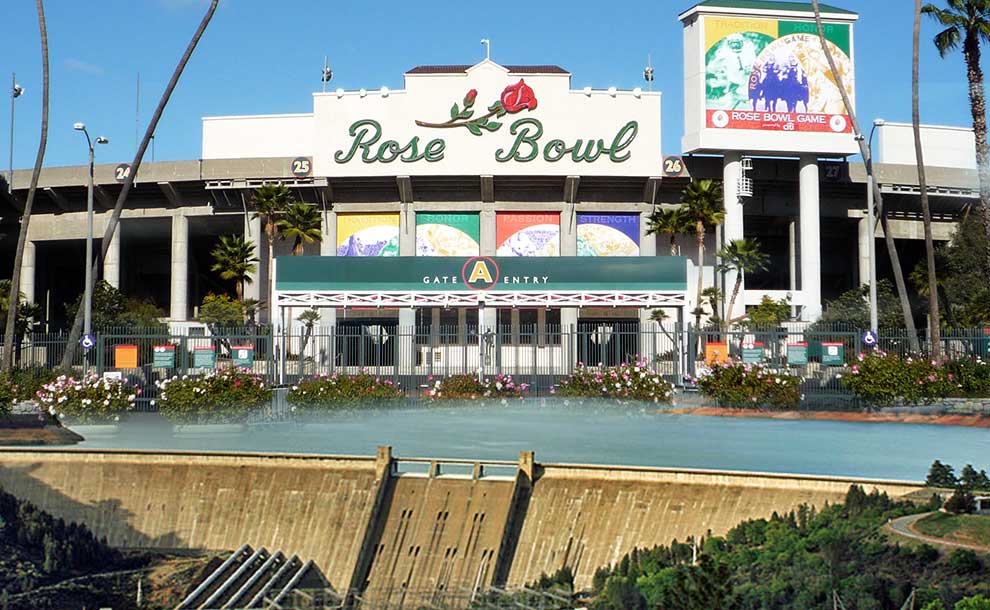
Recap of Pasadena City Council meeting on Sept. 18, 2017 (Rose Bowl Photo – Bobak Ha’Eri, Shasta Dam Photo – Apaliwal).
Issues macro and micro, that is, local and regional, dominated the Pasadena City Council meeting on September 18.
By Garrett Rowlan
On the regional side, the Council had to decide if it would join the mosaic of other communities supporting the WaterFix program, a controversial plan to build tunnels—forty-foot wide, 150 miles below the ground surface—near the Bay Area to help stabilize the flow of water to southern California. The goal is to insure water delivery, mindful of the threat of earthquakes and rising level of saline owing to the global warming, the calving of ice, and the subsequent rise in sea level.
Opponents claimed that the bill was little more than a blank check to Agribusiness, while supporters agreed that it was costly but in the long run cost effective. None of the alternatives would supplant the base-load delivery that Delta water provides. Opponents wanted the Council to delay the vote, while supporters considered it unwise to dither any further, considering the program’s importance. In the end the Council, seeing the need for a stabilization of the infrastructure, decided to opt into the program. Other communities—Burbank, Glendale, and Los Angeles—are due to consider the proposal in the near future.
Spieker Field at the Rose Bowl
The other issue was more local in focus. The Council backed a program that seeks to raise some 40 million dollars to make improvements to the Rose Bowl. The issue here involves naming rights. One man has agreed to donate 10 million of that money for what is considered a more subtle naming than a corporation, avoiding the garish use of freeway signs and a name emblazoned on the field. The needed money will be received and “Spieker Field at the Rose Bowl” will be written in letters 16 inches high on the inner hedges at field level. The Council emphasized that the campaign was the most effective way of striking a balance between the Rose Bowl’ s traditional independence, the various entities (UCLA, the Tournament of Roses, etc.) that have a say-so in the ongoing function of the Rose Bowl game and UCLA home games. In essence, the vote here reflected the principles of the earlier vote on water delivery, that is, providing an ongoing high level of quality, in this case of the stadium itself.
Other issues—the repair of a gas turbine, an evaluation reports on how projects are to be funded from community development block grants—generated less public interest.









Leave a Reply