







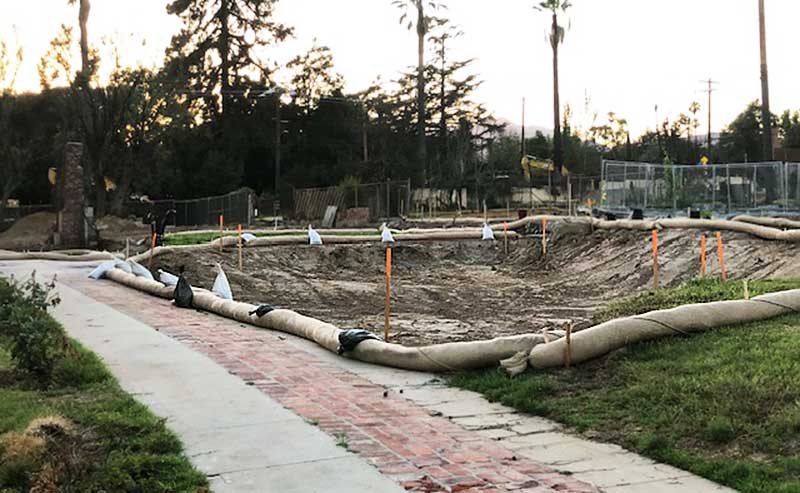
A cleaned up lot in Altadena (Photo – Melissa Michelson)
The Los Angeles County Department of Public Health has released final findings from a months-long soil sampling effort following the Eaton and Palisades wildfires, confirming elevated lead levels in several areas downwind of the Eaton Fire.
By News Desk
The testing, conducted by Roux Associates, Inc. between February 18 and March 26, 2025, analyzed soil and ash samples across both fire zones for harmful contaminants, including heavy metals, dioxins, furans, and polyaromatic hydrocarbons (PAHs). Results were compared to California’s residential soil screening thresholds.
Elevated Lead Levels Downwind of Eaton Fire
The report reveals a concerning pattern of elevated lead concentrations on intact properties located downwind of the Eaton Fire. Of 23 sampling grids in this category, 10 showed average lead levels above the California Department of Toxic Substances Control (DTSC)’s threshold of 80 mg/kg. Concentrations ranged from 80.2 mg/kg to 167 mg/kg.
Officials say the results align with elevated lead levels detected in air samples collected shortly after the fire. The likely source is the combustion of older homes containing lead-based paint, which was commonly used before its ban in 1979. According to the University of Southern California’s Lusk Center for Real Estate, more than 70% of homes in the Eaton Fire area were built prior to that year.
While the findings suggest a link between the wildfire and elevated soil lead, officials caution that soil contamination in urban environments often stems from multiple sources. Additional assessments are needed to determine the specific contribution of the fire.
Limited Chemical Impacts from Palisades Fire
In contrast, the Palisades Fire zone did not show signs of widespread contamination. Only two isolated areas exceeded screening thresholds, one with cadmium and thallium, and another with arsenic and PAHs. These localized findings are not consistent with large-scale wildfire-related contamination, and the source of the chemicals remains unclear.
Soil Safety After Debris Removal
On parcels where structures were destroyed and later cleared by the U.S. Army Corps of Engineers, soil sampling showed generally reduced health risks. However, some areas still exceeded safety thresholds even after cleanup, prompting officials to recommend caution during reconstruction and landscaping. Use of protective equipment and safe soil-handling practices is advised.
Public Health Guidance
Public Health officials stress that the findings are not intended to mandate cleanup or remediation, but to inform residents and guide decisions about further evaluation. Conditions may vary by property, and residents with concerns are encouraged to seek professional soil testing or consult environmental experts.
In fire-affected areas, residents should avoid contact with ash and debris, and use personal protective equipment when working with soil. Precautionary measures are also recommended in neighborhoods where contaminant levels exceeded screening thresholds.
The full report and a detailed FAQ with safety recommendations are available on the Los Angeles County Department of Public Health website.










Lead levels are also likely exceeded in northern Pasadena. Enforce the leaf blower ban!