







OPINION

A recent Alhambra City Council meeting (Photo – Melissa Michelson).
The Alhambra City Council is apt to talk about being respectful after community members speak at city council meetings. However, it appears that respect is in the eye of the beholder.
By Sean McMorris
Often, what Alhambra City Council members view as disrespectful behavior is simply members of the public voicing their opinions and concerns, trying to correct the record, attempting to provide transparency, and questioning city council policy. The Alhambra City Council may not like what they hear, but not liking what you hear and being disrespected are not one in the same. Yes, some people who come to city council meetings speak in frustration. But the city council ought to consider why that is, rather than chastising them about the meaning of respect.
People who attend city council meetings are not children, and they do not need to be lectured about the virtues of respect every time they come before the council. It comes off as patronizing and high-minded, as it suggests that the city council are often disrespected and it presupposes that city council members have never been disrespectful to others. No one, despite what the council may believe, is advocating disrespect, so it is inappropriate for the city council to invoke this word ad nauseam when it suits their narrative.
City council attempts at putting the onus of respect on the public seems unjust for multiple reasons. First, the city council has all the power. They get to dictate the terms of engagement and have final say on decisions that affect all of our lives. Second, many of the people who speak at city council meetings are vulnerable. Most of the time, people who take the time to go to a city council meeting and publicly speak are there because other efforts have failed them. Their concerns have either fallen on deaf ears at city hall or they were not adequately addressed by city staff and/or city council members. In short, many people who speak at city council meetings are desperate, not disrespectful.
Voicing opinions
and concerns
about local
government
…is the most
fundamental check
on government
that we have
When you are desperate and knock politely for help on a door and are ignored, it is natural to start pounding on that door. If you are then chastised for making too much noise by pounding on the door, it is then natural for desperate people to break down the door and demand relief from the people who can supply it. Many would argue that the respectful thing to do would have been for the city to have addressed the concerns of desperate community members when they knocked politely, not chastise them for having broken down the door to seek relief.
That said, if the Alhambra City Council is going to preach Respect with a capital “R,” then they should at least adhere to the level of respect that they demand of their constituents. Yet, Councilman David Mejia‘s statements about cyberbullying in the most recent issue of the Around Alhambra calls into question the sincerity of the city council’s respect mantra.
Public opinion and free press outlets
For many of us, social media has become an integral part of our everyday lives. Most people utilize social media outlets, like Facebook, primarily to stay connected with friends and family, but also to express themselves. But social media has evolved over the years to include sites like Nextdoor that let people connect with their neighbors as well as with completely online free-press publications. Yet, for many people who live under oppressive governments, social media is the only place for them to access unsanctioned news and information. Social media allows those same people to share information and express their opinions, often under an alias, with less fear of state sanction.
To be sure, some people use social media outlets to promote hate and harm upon others, and that is abhorrent and wrong and should be mitigated accordingly. But the people who abuse social media do not account for the vast majority of social media users. Thus cyberbullying, which Dictionary.com defines as: “to bully online by sending or posting mean, hurtful, or intimidating messages, usually anonymously,” is a very serious issue. However, it should never be equated with public opinion and/or one’s right to be critical of government — and it certainly should not be exploited for political gain.
Mejia’s troubling op-ed
That is why Councilman Mejia’s (then mayor) op-ed in the Around Alhambra, which goes out to every resident of Alhambra and is distributed at city hall, is so troubling. Mejia devotes the majority of the Mayor’s Corner section of the Alhambra Chamber of Commerce publication to the topic of cyberbullying. He begins his statement on the topic by correctly identifying cyberbullying as an offense with potentially tragic consequences, primarily within the youth community. He then devotes a sentence to praising AUSD’s Gateway to Success program, which discourages students from cyberbullying. He ends the first paragraph by stating, “I believe this topic is very important because everyone needs to know that it is a terrible epidemic, and everyone needs to discourage cyberbullying.” Had Councilman Mejia ended his statement on the topic there, it would have been a good public statement against cyberbullying. But Councilman Mejia goes on to devote the next five paragraphs to attacking critics of city hall by equating them with cyberbullies.
Councilman Mejia writes:
Since being elected to Alhambra’s City Council, I have read many comments on social media applications and internet-based newspaper articles in which members of our community and organizations representing Alhambra bully, insult, and provide misleading information to the residents of Alhambra. Individuals who behave this way are doing the community an injustice and are guilty of cyberbullying.
Councilman Mejia then singles out the social media site Nextdoor, which the Alhambra Police Department uses extensively as “a political forum that provides misleading information and is used to trade insults and bully community members who have opposing views.” The councilman does not provide examples.
Then Councilman Mejia goes after the Alhambra Source by stating that “community members contribute articles to a local internet-based community newspaper with inaccurate and misleading information.” It is important to note here that the only local (i.e., Alhambra) internet-based newspaper that allows community members to contribute is the Alhambra Source.
Councilman Mejia ends his soapbox on the subject by stating:
Community members on these forums complain and ridicule the City of Alhambra on the misuse of funds. So, if we are going to teach our children that cyberbullying is a terrible thing, we as adults should lead by example and stop this type of behavior.
Outrageous blanket claims
These accusations against community members, local organizations, and free press outlets who have been critical of city hall are outrageous blanket claims that Councilman Mejia has yet to back with any kind of evidence whatsoever. He singles out one article in the Alhambra Source without providing a reference in which he claims that information about funding for the Alhambra Arc de Triomphe was inaccurate, but the only potential articles about that subject I could find in the Alhambra Source were a series of 2010 articles and a survey in which the Alhambra Source reported about public opinion on the Alhambra Arc de Triomphe. Reporting on public opinion and the results of surveys does not constitute inaccurate and misleading information — and it certainly does not constitute cyberbullying. Besides, if city hall thinks that something in the Alhambra Source is inaccurate, then they can request that the record be corrected by providing evidence to substantiate their claim.
Needless to say, Councilman Mejia’s statements in the Around Alhambra about cyberbullying sparked multiple responses on Nextdoor, most of which were not kind to Councilman Mejia’s depiction of the social media site as a cyberbullying bazaar and source of misinformation in which local political matters are supposedly out of bounds. For the record, Nextdoor policy allows for the posting and discussion of local political matters, but discourages posting about state and national political matters. Nextdoor also has a process for reporting uncouth behavior and reserves the right to suspend users who act inappropriately.
Exploiting a serious issue for political gain?
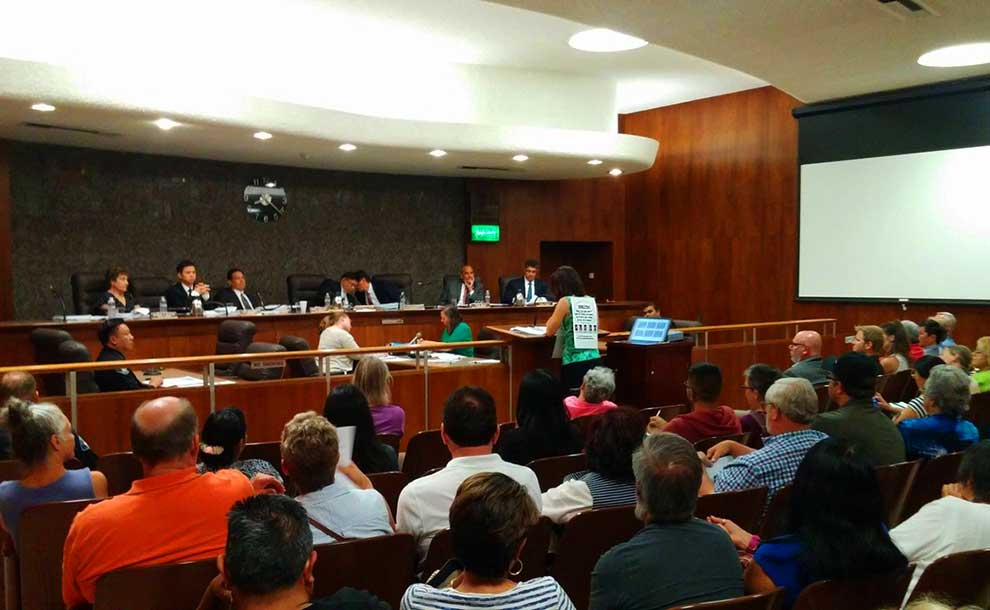
Alhambra City Council, Sept. 11, 2017 (Photo – Rohan Sabnis).
It appears that Councilman Mejia either does not understand what cyberbullying is, or worse, he deliberately exploited a very serious issue for political gain, and in so doing, diminished the seriousness of cyberbullying, thus squandering the opportunity to better educate the public on the matter.
Yet, even more troubling is that Councilman Mejia’s op-ed appears to be an attempt at silencing and shaming current and potential detractors of city council policy through propaganda that is published by the Alhambra Chamber of Commerce, an organization that restricts others from joining and is biased in its policy views, does not represent the community as a whole, and has received for many years, two annual no-bid city contracts worth hundreds of thousands of dollars.
My speaking publicly about these contracts is not bullying; It is being transparent. It is not misinformation; it is fact. If the Alhambra City Council finds it insulting, then too bad. Many in this community believe that these contracts should not exist. That they do raises questions of impropriety and bias. The community has a right to scrutinize these city contracts as well as all other decisions made by city hall without fear of city council or Alhambra Chamber of Commerce retaliation.
In short, Councilman Mejia’s statements in the Around Alhambra appear by many to be an attack on the first amendment rights of community members and press organizations who have been openly critical of Alhambra’s government — and that is a very slippery slope for a democratically elected official to go down.
Councilman Mejia has set a terrible precedent with his statements in the Around Alhambra, as he has laid the groundwork for city hall to publicly label and shame members of the community who are openly critical of local government in the future. And the rest of the city council and Alhambra Chamber of Commerce are complicit if they condone such behavior.
To be clear, people and organizations voicing their opinions and concerns about local government is not bullying; it is freedom of speech, which is the cornerstone of democracy — it is the most fundamental check on government that we have.
Hypocrisy is unbecoming of elected leaders
In closing, hypocrisy is unbecoming of elected leaders, but doubly so when those leaders speak of respect ad nauseam. Exploitation of serious issues for political gain is even more abhorrent. Disagreement, transparency, emotion, and questioning of city council policy do not equate to disrespect, and it certainly is not tantamount to cyberbullying. I hope that in the future, the city council will remember this when it is voting on contracts, large developments, and other matters that affect community members’ lives. It would also behoove city council members to keep this in mind when addressing members of the public both formally and informally, campaigning, and publishing official statements in the Around Alhambra.
Read More:
Alhambra:
More Questions Raised Than Answered
 at Alhambra’s City Council Meeting














Hypocrisy seems to have no bounds and it is impossible to pick a point to even begin to address issues presented here. At best Leftists activists spend too much time promoting solutions for problems that do not exist.
She was rude, her face showed it all. And eating and chewing while someone is photographing you? Yuck!!!!
Here is Alhambra City Councilwoman Barbara Messina in action: https://www.youtube.com/watch?v=8BgdCaZ6xgA A constituent wanted to talk to her after a city council meeting at the mayor’s reception– a reception paid for by constituent tax-dollars, no less. If she didn’t want to be filmed, she could have said so, but instead, she bullies her constituent.