







SCIENCE CORNER
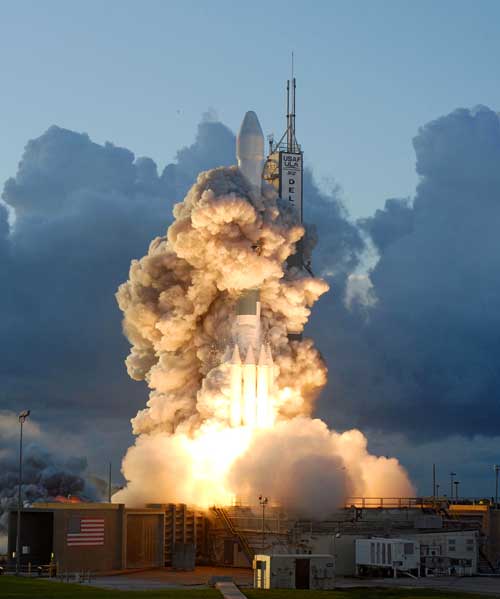
Dawn launched at dawn (7:34 a.m. EDT) from Cape Canaveral Air Force Station, Sep. 27, 2007 (Photo – KSC/NASA).
Eight years ago today, Dawn was gravitation-ally bound to a planet.
By Dr. Marc D. Rayman
It was conceived and built there by creatures curious and bold, with an insatiable yearning to reach out and know the cosmos. Under their guidance, it left Earth behind as its Delta rocket dispatched it on an ambitious mission to explore two of the last uncharted worlds in the inner solar system.
As Earth continued circling the sun once a year, now having completed eight revolutions since its celestial ambassador departed, Dawn has accomplished a remarkable interplanetary journey. The adventurer spent most of its anniversaries powering its way through the solar system, using its advanced and uniquely capable ion propulsion system to reshape its orbit around the sun. On its way to the main asteroid belt, it sailed past Mars, taking some of the that red planet’s orbital energy to boost its own solar orbit.
On its fourth anniversary, the probe was locked in orbit around the giant protoplanet Vesta, the second most massive object between Mars and Jupiter. Dawn’s pictures and other data showed it to be a complex, fascinating world, more closely related to the terrestrial planets (including one on which it began its mission and another from which it stole some energy) than to the much smaller asteroids.
Doing what it does best
The only spacecraft
ever to orbit
two extraterrestrial
destinations…
Today, on the eighth anniversary of venturing into the cosmos, Dawn is once again doing what it does best. In the permanent gravitational embrace of dwarf planet Ceres, orbiting at an altitude of 915 miles (1,470 kilometers), Dawn is using its suite of sophisticated sensors to scrutinize this mysterious, alien orb. Ceres was the first dwarf planet ever sighted (and was called a planet for more than a generation after its discovery), but it had to wait more than two centuries before Earth accepted its celestial invitation. The only spacecraft ever to orbit two extraterrestrial destinations, this interplanetary spaceship arrived at Ceres in March to take up residence.
Final anniversary
Although this is the final anniversary during its scheduled primary mission, Dawn will remain in orbit around its new home far, far into the future. Later this year it will spiral down to its fourth and final orbital altitude at about 230 miles. Once there, it will record spectra of neutrons, gamma rays, and visible and infrared light, measure the distribution of mass inside Ceres, and take pictures.
Then when it exhausts its supply of hydrazine next year, as it surely will, the mission will end.
Dr. Marc D. Rayman is the Dawn Mission Director and Chief Engineer at JPL. Marc greatly enjoys sharing the thrill of interplanetary adventures with the public.













Leave a Reply