









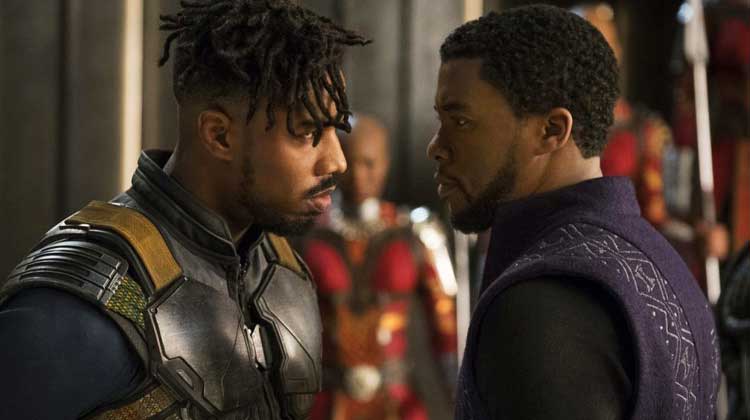
Black Panther (Photo – vimeo.com).
We’ve all heard the term “Think Globally, Act Locally.” To use a film as an example of its application might seem unusual, especially a big budget commercial blockbuster like Black Panther, but hear me out.
By Kent Matsuoka
Sure, it’s a diverse film that fits all the feel-good boxes of diversity and feminism, and easy for others to disregard the film as an unrealistic Afro-futurist utopia; however, it’s also so much more. Ryan Coogler has transcended the traditional genre film model with Black Panther, and the Marvel universe will never be the same again.
As with any superhero movie, it relies on the familiar trope of good vs. evil. What separates our favorite superhero movies from the typical studio summer blockbuster is the depth of the characters, most specifically in regards to the villain. In this regard, Coogler hits it out of the park with a complexity not usually associated with the genre.
Michael B. Jordan’s portrayal of Killmonger is what separates Black Panther from being more than just another black movie, or just another superhero movie, but one that is universal. If conservative white audiences who wouldn’t normally watch “black films,” or liberal film-school grads who refuse to watch “commercial superhero movies” can look beyond their self-imposed filters of what constitutes good cinema (and judging from the box office many have), they might just find something worth exploring.
Killmonger gives Chadwick Boseman’s T’Challa depth by not just being the opposite of the hero, but has relatable desires and motivations, a sympathetic villain who causes the hero to reevaluate his own beliefs, and whose arc seems more like a tragedy than a triumph.
That Killmonger’s back story as a CIA operative is an important reference not to be missed. The traditional tropes of American cinema have been interwoven throughout the film, and turned upside down as Killmonger isn’t just a product of the military-industrial complex, but also a product of American society as a whole. He provides a familiarity that T’Challa’s polished demeanor as a confidently privileged and protective member of the landed gentry does not.
The message throughout is that nothing is ever black and white, but that there are advantages and disadvantages to any situation that a single-issue mindset can blind one to the secondary ramifications to their beliefs.
Key among these are the desire for isolationism and protectionism, which may allow a weaker country/organization/ideal enough traction to compete, but can create a huge blind spot once they’ve reached a position to succeed and are unable to scale upwards to remain competitive against other similar groups.
Another would be the classic lesson of “beware of Greeks bearing gifts.” It’s the reverse of “you catch more bees with honey,” an effective trade-craft tool to ingratiate an operative within a faction of a rival country/organization/ideal, and then poison their minds from within.
It’s also the origin of the frequently misused term “divide and conquer.” To divide and conquer doesn’t mean to split your own forces up in order to cover more ground, but to create bias and distrust among the allied factions of your opponents so they fight each other, allowing a third power to easily step in and take power.
We can see numerous examples of this tactic used throughout the world today, as social media has given voice to extreme views that can be twisted to sound reasonable, and used to disrupt the overall direction of a movement by pitting two factions with corresponding end goals against each other instead of focusing on the larger enemy at hand.
From economists to foreign correspondents, and political scientists to sociologists, many academics have already weighed in on the feasibility of Wakanda to develop as portrayed, and the effects it could have on the world as a whole were such a country suddenly to appear. They’ve dissected the resource curse paradox and compared the real world history of Botswana and Congo. They’ve debated whether aid is more effective than direct investment in promoting equality, how to avoid colonialist implications, and how a new global Wakanda would handle migration and trade.
 Unfortunately, all these discussions miss the forest for the trees. As with Killmonger’s singular desire for an imperialist black liberation with himself as king, they’re both based on an unsustainable “think local, act global” point of view, projecting singular issues and interests on the world as a whole.
The film and its message are both of and apart from the insidious tactics of Killmonger himself, depending on how one interprets the message. If all one gets is the singular us versus them message that Killmonger espouses, they will have allowed themselves to be distracted from the big picture as Daniel Kaluuya’s W’Kabi.
I believe it was Coogler’s intention for viewers to question the basis of their own beliefs and allow for introspection to seek a better, more inclusive way of obtaining their goals to the betterment of the world as a whole, much as T’Challa himself, as he broadens his viewpoint regarding the world from a closed community based view, to an inclusive global viewpoint necessary as a true world power.
Only through an attempt to understand how the world as a whole applies to our own communities can we start to move forward and create a neighborhood that benefits the entire city, moves the city forward to benefit the entire region, and moves the entire region forward to the state and so on, until we’re able to see and treat a family on the other side of the world the same as we treat our neighbors on the same street, the members of our church, and the families of our children’s best friends.
It’s only then will we achieve peace, harmony, and equality that everyone claims to want, but more often than not, we get caught up projecting selfish community issues on the world around us, regardless of whether it has a negative bearing on the world as a whole, and causes the divisions that lead to collapse on a state, federal, or even global scale.
Kent Matsuoka is a producer and location manager in Hollywood.












Leave a Reply