




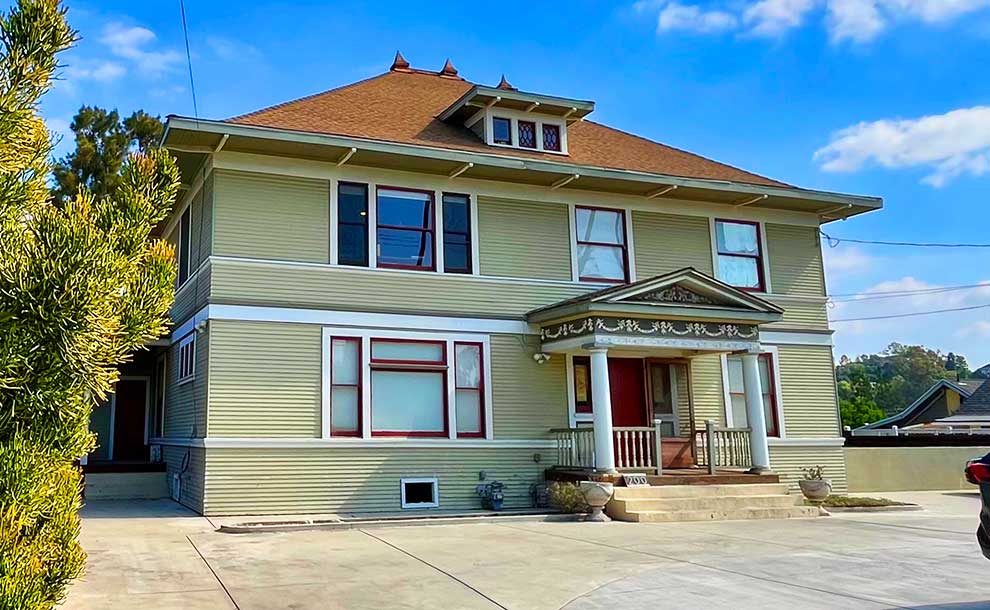
Original Suffragist House in Highland Park (Photo – Matt Hormann)
Located on North Avenue 66, the Victorian home was once a way station for women’s rights activists.
By Matt Hormann
Within its three wood-framed stories, early women’s rights advocates plotted strategies for equality, including an 1896 California ballot initiative for women’s voting rights.
Situated at the intersection of N. Avenue 66 and Garvanza Avenue, the home was commissioned and built by two pioneering suffragists: Cora Scott Pond-Pope and Anna Howard Shaw. Pond-Pope, a university-trained playwright, organized eighty-five Woman Suffrage Leagues over her lifetime. Shaw was famous for being the first woman ordained in the Methodist Episcopal Church and the first woman to win the Distinguished Service Medal.
Built on Cooper Avenue (later renamed Ave. 66) on a lot purchased from the Garvanza Land Company, the home became a bulwark of the local women’s rights movement. “For over a decade [it] was used for meetings, as a woman’s home, and according to some cryptic news articles, may have been the location of a ‘secret society’ of young women,” notes a nearby historical marker. From 1887 and 1897, the house served as a meeting place for suffrage workers and a lodge for female travelers.
Sadly, in 1897 Shaw and Pope were obligated to sell the house after California Ballot Measure 6 — a women’s suffrage bill in which they had invested heavily — failed, according to the Los Angeles City Planning Department.
Pond-Pope, however, persevered as a savvy Los Angeles real estate developer. She later purchased the land that became Mount Angelus, christening streets in the district after three prominent abolitionists: Livermore Terrace (Mary Livermore), Stowe Terrace (Harriet Beecher Stowe), and Garrison Drive (William Lloyd Garrison).
“If I win out in my real estate deals I hope to spend many years yet in the service that I love, urging greater justice to the mothers of our race,” she wrote in 1914. “And to give equal laws and equal suffrage to men and women — equality for all alike before the law for every race and clime and color.”
Shaw’s work continued until her death in 1919, one year before Congress passed the 19th Amendment.
Over the years, the Pond-Pope/Shaw residence changed hands several times, even serving briefly as a fraternity house. By 1970, a real estate ad noted that “a lot of work [is] needed to revive this gem & once again have a ‘showplace’ […] on what was one time Highland Park’s most elite street.” By 2016, a full restoration had taken place, with assistance from preservation groups, and today the home is once again proudly — and privately — owned.










Leave a Reply