







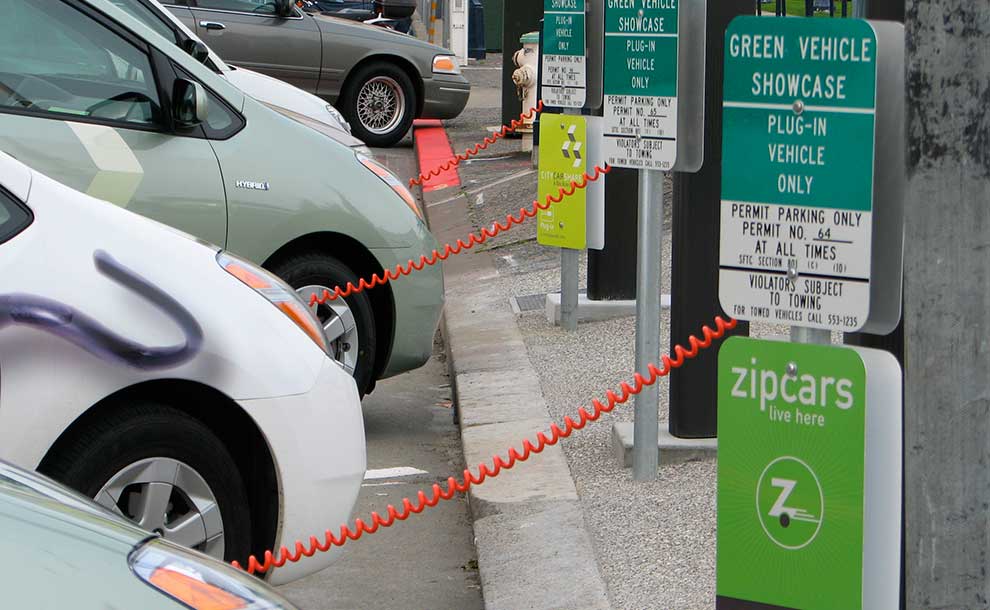
EV charging station (Photo – Felixkramer, flickr).
Electric vehicles are good for the environment not just because they decrease petroleum fuel burning, but because the batteries in the vehicles can help support a cleaner grid.
By Ethan Elkind
To test that concept, BMW signed up drivers of their electric i3 vehicle for a project with Pacific Gas & Electric in the Bay Area. The basic goal was to reduce demand from a fleet of vehicles at a time when the grid was constrained, by activating software in the vehicles to halt charging for up to an hour.
The upside for drivers who participated?
The participating drivers got $1000 for signing up, plus as much as $540, depending on how many days they did not manually opt out of the program. Drivers were notified by a software app when a delay was about to happen and could use it to opt-out if needed.
In practice, that meant eight delays in charging over the 18-month pilot period for the typical driver. However, some vehicles, based on when they were plugged in and how little they opted out, had more delays. Of the 100 participating drivers, for example, three vehicles participated in over 50 events.
A good deal
If it sounds like a good deal, that’s because it is. In fact, 500 drivers ended up applying for just 100 spots in the pilot. The report did not mention if the payments were cost-effective from a ratepayer standpoint (I suspect not). In other words, could that electricity have been more cheaply supplied or reduced elsewhere? But given that this was a pilot, it was important to get data and participation first.
During the 18 months (from July 2015 to December 2016), PG&E asked BMW 209 times to “provide capacity of 100 kW over an hour-long period.” This is actually a lot of times. As a point of comparison, residential “demand response” (as this kind of moderated demand is called) programs are capped at 15 events per year.
Ultimately, BMW met 90% of the events. The reason for the failings was mostly due to technical problems, which apparently got fixed as the pilot went on. And the response time to actually delay the charging once the utility sent the signal was 2.3 minutes on average, which was fine for the day-ahead market and not bad for the real-time market, which requires 4 minutes at most of delay. The lag was mostly due to communications issues that seemed to get fixed as the pilot unfolded.
Drivers did not mind delays
Drivers seemed not to mind the delays. The most opt outs for any one event was on Thursday, October 14, 2015 at 11 PM, when three customers opted out. The majority of events had no opt-outs and only two participants opted out for more than two events over the entire pilot. Meanwhile, 95% of the drivers surveyed said that they never, or rarely, had to change driving or charging behaviors. Ultimately, 98% indicated they were satisfied with the experience.
But there was one relatively big hitch to the findings: not enough EV drivers were plugged in at any given moment to meet the demand response events. As a result, BMW had to rely on “second-life” used electric vehicle batteries to meet almost 80% of the power requested during these events. The vehicles on average supplied the other 20% of the demand reduction.
Possibly because of time-of-use rates and cheap off-peak power, many drivers did not plug in until after 9pm. As a result, these drivers simply missed any demand response events happening during the daytime or early evening. In fact, only 37% of the drivers charged at work during the day, due to the lack of availability of chargers at their place of employment.
Meanwhile, the drivers that were able to participate in the top 10%:
[A]re characterized as frequent drivers, who have regular charging patterns and are not on a [time-of-use] rate. These drivers habitually plug in and begin charging around 8 PM in the evening and typically charge for about 3 hours. Since a majority of the events were called from 8–9 PM, these vehicles were frequently called upon and able to participate.
So in the long run, more workplace charging and electricity rates that encourage demand response participation could address these challenges.
Meanwhile, the benefits to the grid look very promising. Each vehicle contributed 4.43 kw of demand response delayed usage. It may not sound like much, but assuming by 2030 the state has 1.2M electric vehicles, with 250,000 drivers enrolled in this kind of program and 17,000 participating in a demand response event:
[T]he potential load drop of a single event in 2030 is about 77.6 MW, which is enough to power approximately 58,000 homes in California. Thus, on a larger scale, a similar program has the potential to provide a significant resource.
Conclusion
So while more work remains to be done, this pilot project is overall very encouraging. Coupled with reforms related to boosting workplace charging and improving electricity rates (the subjects of a forthcoming report from UC Berkeley and UCLA Law), this kind of demand response could be very beneficial for the state.
And it could put a healthy dollop of cash in EV drivers’ wallets to boot.
Ethan Elkind directs the climate program at UC Berkeley Law, with a joint appointment at UCLA Law. His book “Railtown” was published by the University of California Press in 2014.












Leave a Reply