







REVIEW
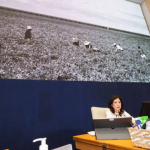
Eclipse exhibition at the ArtCenter in Pasadena (Photo – artcenter.edu).
While it would be an exaggeration to say that every generation gets the eclipse it deserves, certainly the exhibit centered around the upcoming eclipse—a presentation of the Williamson Gallery at the Art Center College of Design—leads one to conclude that the upcoming celestial event is a human phenomenon as much as an astrological one.
By Garrett Rowlan
Eclipse, as the show is eponymously named, brings artistic, technological, and historical foci to the phenomenon of planetary alignment and the darkness it brings.
Artistically, there is artwork by a variety of artists depicting a black sun which becomes, in Lita Albuquerque clever metaphor—included in her wall-sized, image-and-text projection—a pupil in the eye of the universe. Indeed, seeing those dark, luminous celestial spheres in paintings by Jacqueline Woods and others, one can’t help but think that while we are looking out at the universe, the universe is looking back.
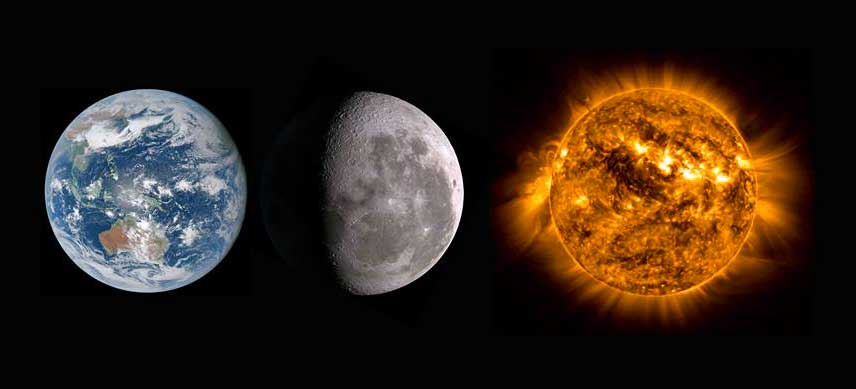
And moving around us also. In one room, the opening scene of Bella Tarr’s film Werckmeister Harmonies (where denizens of a late-night bar are pushed and steered to suggest the movement of celestial bodies) is juxtaposed with depictions, on the other three walls, of the earth, moon, and sun—the latter depicted as a fiery orb continually sprouting flares like unruly cowlicks—as they move in and out of shadows, creating an impression of microcosmic and macrocosmic relation.
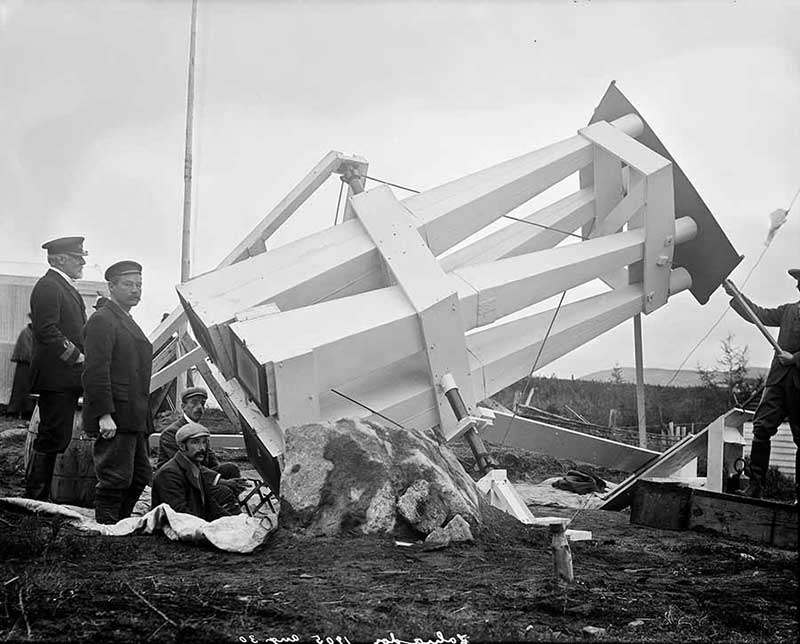
The Lick Observatory Intramercurial Camera, mounted at Sandwich Bay, Labrador, for total solar eclipse of August 30, 1905.
Scan of Glass Plate, From film by Tony Misch and Simon Holland (Photo – University of California Observatories / Lick Observatory).
Other exhibits place an eclipse in historical context. There are documented—in photos, journals, and bulky objects—earlier expeditions to various part of the globe to document eclipses. And though the purpose of those journeys is to better understand a scientific occurrence, one cannot but help think of a modern pilgrimage, complete with journals whose careful notations plot parallax and shadings, the heavens no longer a place of angelic repose but of gravitational relations.
In another gallery, the eclipse over London in 1652 produces both an astrological explanation and a Christian refutation, and the idea of a darkness moving over the land was not far from this reviewer’s thoughts, still reeling from hearing the latest cawing outrage from the 45th president, whose ruddy features and flaring hairstyle suggests a bright star in need of its own eclipse.
Cultural apocalypse aside, Eclipse, due to run until September 10, is well-worth a drive into the hills above Pasadena, a step closer to the stars.
Garrett Rowlan has been writing all of his life. In addition to being a writer, Garrett is a big supporter of social justice issues. His first novel will be published next year.










Leave a Reply