

LOSING A HOUSE

Horses entering Starbucks drive thru (Photo – Matt Hormann)
It’s a cloudy day in Highland Park and there are horses in the Starbucks drive-through. Yes, horses. With riders. They patiently wait their turn behind a pickup truck, as their riders joke with one another.
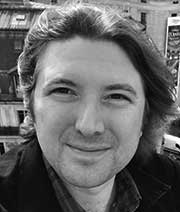
By Matt Hormann
It’s one of many delightful scenes I’ve witnessed during my four and a half weeks living here after my Altadena home burned down during the Eaton Fire. I arrived at my girlfriend Tera’s house on January 7th with a few boxes of photos, a hamper of dirty laundry, and my cats, Ruby and Ruffles. A “soft landing,” she called it.
The cat scratch on my hand from loading Ruby into her carrier that night has faded, but the trauma of loss and displacement remains. A staggering 17 people died in the Eaton Fire; an additional 26 are still missing. My housemate John heroically stayed until 6:30 am on January 8, hosing the house down until it finally caught fire.
Flashes of memory stand out from that evening: caustic smoke, frightened housemates, the volcano-like glow emanating from dark billows of ash. An entire downed Magnolia tree on Avenue 64. The horrible decision of what to take and what to leave behind.
Today, along York Boulevard, however, the clouds are beautiful, the air clean. It’s the second rain we’ve had after the horrific conflagrations of early January, and the earth seems able to breathe again. Highland Park breathes too — its own kind of life. Every intersection is saturated in history and life.
Tera lives in an elegant 1876 Victorian home in Garvanza, a sub-neighborhood of Highland Park. It’s featured in a local history book.
Six cats reside with us, with another who doesn’t trust humans (which makes two of us) orbiting the property. Tera calls it “Cat Springs” and makes up little songs for the kitties in the morning. Her garden, shaded by a Chinese Elm and Jacaranda and complete with a full-sized yurt, inspires tranquil contemplation.
Garvanza predates Highland Park. Street signs erected in 1997 identify it as a separate neighborhood, which it once was. It’s quieter and closer to the Arroyo than the rest of Highland Park. A collection of mid-century homes built in 1961 called Arroyo View Estates provides contrast to older homes like the Dr. Smith House, built in 1886 or the 1887 Suffragist House on Avenue 65, which served as a way station for early women’s rights activists.
As PBS SoCal notes, “Garvanza was one of the many sectioned plots of the Rancho San Rafael and was mainly a collection of garbanzo bean fields—hence its original name ‘Garbanzo.’”
“Location elevated, and unsurpassed for BEAUTY, CONVENIENCE and SOIL,” read an L.A. Times real estate ad from 1886. “Supplied with the PUREST WATER!” (The water’s still some of the best in the city, incidentally.)

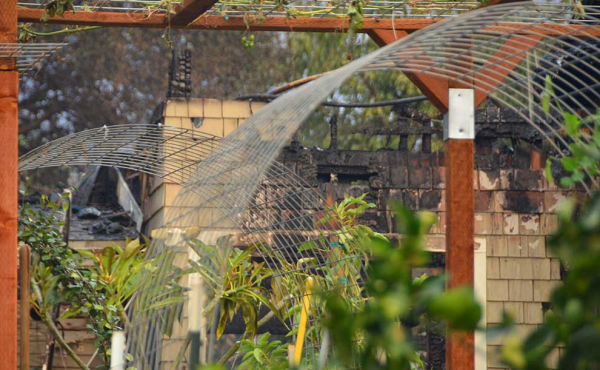
Remnants of a structure in Highland Park (Photo – Matt Hormann)
There are so many wonderful, quirky things in the neighborhood: the house that goes all-out on Halloween, complete with a full-size talking Darth Vader; glassmakers Judson Studios; the Hi-Ho liquor store; the Offbeat Bar, which does exceptional drag shows.
I’m reluctant to bid goodbye to the horses at Starbucks, but my car’s in the shop and I have to get to the Metro stop before I’m late for work. I walk past the veterans memorial and the cute Arroyo Seco branch library on Figueroa, built in 1960. Nearby is the eminently cool L.A. Police Museum, one of the first places I went after the COVID lockdowns ended in 2021. They’ve got Patty Hearst’s submachine gun from her time with the SLA, Charles Manson’s letters, and the North Hollywood bank shootout car.
As I walk west on Figueroa — past a sign for “Smokin’ Bones,” a long-since defunct BBQ joint — a man approaches, muttering. “Be careful, bro,” he says. “You’ll get murdered.” I realize he’s on his phone.
After what seems an eternity waiting for two trains to pass, I cross the tracks and saunter on past Taco Bell and what must be the world’s oldest and most unloved payphone. I cross the street at Avenue 60.
In front of a strip mall that’s home to the “Union of Horologists” and Tacos Ensenada, a boy of about eight hops excitedly on the back of his mom’s bicycle, like a cowboy mounting a horse. “Careful!” he motions with his hand to car pulling out of a driveway.
Figueroa is imbued with old L.A. vibes. One can see why filmmaker Quentin Tarantino shot a good chunk of his crime film debut, Reservoir Dogs, nearby. (Cheech & Chong’s Up in Smoke was also shot partly in Highland Park.)
I pass Kitchen Mouse, a hipster brunch spot with excellent vegan options. A row of homeless tent encampments along Avenue 59 doesn’t escape my notice. It wasn’t there a month ago — a reminder of ongoing societal issues transcending natural disaster.
When I was 18-19, I drove through this neighborhood in my car at night capturing decaying building, fading signs, and other scenes with my Pentax. I remember one photo in particular of a neon sign that simply read “Coldest Beer in Town.” Remarkably, the sign remains, but now it’s an boutique hipster shop — more “craft IPA” than Mickey’s Big Mouth.
Which leads me to the uneasy realization of burgeoning — in fact, exploding — gentrification. It’s been happening for years, but a drive down York Blvd. towards Eagle Rock gives the sense of an unsustainable and, in many ways, unwanted, expansion. I shudder to think how it’s driving up rents and displacing longtime residents.
I’m almost at the Metro stop now. No animals in sight today, though experience tells me the ubiquitous neighborhood parrots can never be far away. As I approach the train stop, there’s a man crooning Irving Berlin’s “Cheek to Cheek” into a microphone karaoke-style at a small outdoor market on Avenue 58, complete with a full instrumental backing track. I cannot honestly tell if he’s singing or lip-syncing. It’s so very L.A.
As I board the train I think to myself: I’m going to like it here.










Leave a Reply