








SCIENCE CORNER
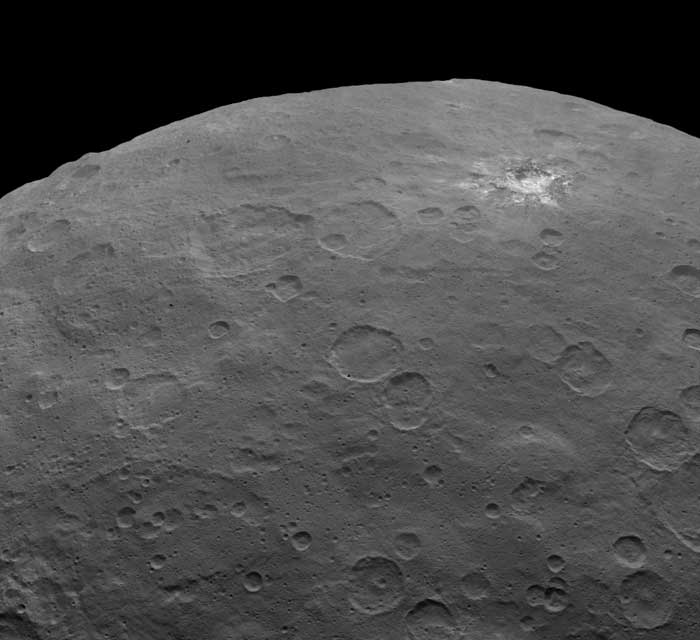
A bright material is easily visible inside and around the crater near the upper right. Did the powerful impact that excavated the crater deposit bright material that it brought from elsewhere in space, excavate bright material from underground or create the conditions that subsequently caused some material to become bright? The reason for the greater reflectivity is not yet known. Photo – NASA/JPL-Caltech/UCLA/MPS/DLR/IDA
Dawn continues to unveil a “Ceres” of mysteries at the first dwarf planet discovered.
By Dr. Marc D. Rayman
The spacecraft has been extremely productive, returning a wealth of photographs and other scientific measurements to reveal the nature of this exotic alien world of rock and ice. First glimpsed more than 200 years ago as a dot of light among the stars, Ceres is the only dwarf planet between the sun and Neptune.
Dawn has been orbiting Ceres every 3.1 days at an altitude of 2,700 miles (4,400 kilometers). On June 30, it completed its eighth and final revolution.
And what marvels Dawn has beheld! How can you not be mesmerized by the luminous allure of the famous bright spots? They are not, in fact, a source of light, but for a reason that remains elusive, the ground there reflects much more sunlight than elsewhere.
Ceres data
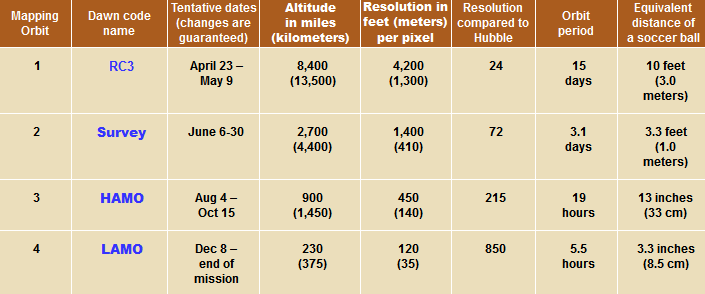
Chart – .jpl.nasa.gov
Although scientists have not yet determined what minerals are there, Dawn will gather much more data. As summarized in this table, our explorer will map Ceres again from much closer during the course of its orbital mission.
New bright areas have shown up in other locations too, in some places as relatively small spots, in others as larger areas (as in the photo above), and all of them will come into sharper focus when Dawn descends further.
Ceres
will be
the ultimate
arbiter
What do you think?
Join more than 100,000 others who have voted for an explanation for this enigma. Register your opinion for what the bright spots are.
Ceres will be the ultimate arbiter, and nature rarely depends upon public opinion, but the Dawn project will consider sending the results of the poll to Ceres, courtesy of our team member on permanent assignment there.
Dr. Marc D. Rayman is the Dawn Mission Director and Chief Engineer at JPL. Marc greatly enjoys sharing the thrill of interplanetary adventures with the public.













Leave a Reply