





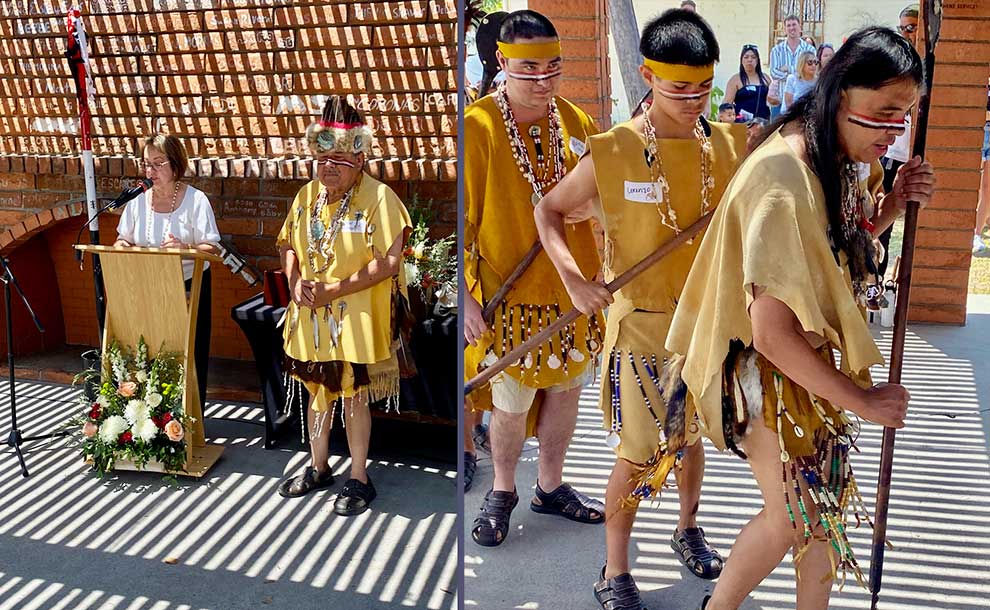
(L) Senator Maria Elena Durazo with chief Anthony Morales. (R) Celebrating the return of a one-acre parcel (Photos – Brian Biery)
On a blistering hot August day, the Gabrieleno-Tongva San Gabriel Band of Mission Indians celebrated an important milestone in the tribe’s history: the return of a one-acre parcel from the Presbyterian Church’s Presbytery of San Gabriel. The restoration of Siban’gna was significant not only because it will provide the tribe with a cultural center for practicing its traditions and ceremonies, but also because it publicly acknowledges that the land was taken from the tribe during California’s Spanish colonial period.
By Brian Biery
Elder, historian, and former Tribal Chairman Art Morales shared that, “The significance [of this transfer] is everything to us. The government had outlawed our dance, our music, our culture, everything… until the 1980s. When my daughters were in high school, the history books said we were extinct. You never want to get overconfident because of what we’ve been through, but things are in a great position right now.”
Records show that the Tongva have lived in the greater Los Angeles region for thousands of years, with hundreds of village sites still found today around the Southland. The Tongva were first subjugated by the Spanish mission system, which sought to expand Spain’s control over California. With the founding of the San Gabriel Mission Arcángel in 1771, Tongva families near the mission were forced to work for Catholic priests who managed the operations of the compound. As the Spanish colony expanded, it either destroyed or absorbed the remaining Tongva villages.
Since that time, Native American tribes across California have struggled to reclaim their lands, whether through federally recognized reservations, direct purchases, or the return of property by private owners, as in the case of Siban’gna. In 1891, the federal Mission Indian Agency began the process of creating Indian reservations in Riverside, San Bernardino, and San Diego counties. Unfortunately, the Gabrielino/Tongva were not included in that initiative, nor in a subsequent Bureau of Indian Affairs effort in 1951, partly due to the high price of land in Los Angeles County.
Thus, the restoration of Siban’gna is immense to the San Gabriel Band of Mission Indians, as it provides the tribe with a home just a block away from the San Gabriel Mission. To put this accomplishment in perspective, a recent Federal Indian Claims Commission report noted that the Gabrielino/Tongva were wrongly deprived of 1,553,772 acres of land in Los Angeles County. The returned land had previously been used as the Presbytery’s La Casa de San Gabriel Community Center, which offered a variety of social services to the community for over 80 years, occupying a parcel the size of one small city block.
Kimberly Morales Johnson, Tribal Secretary for the SGBMI said, “This transfer of land is a lot different because it punctuates the connection that the tribe has had to the mission and the historic district. My grandparents lived here. All the tribal members have family here, or live in San Gabriel. So you are talking about generations of folks who only knew this site in this little town. We know that the land that is underneath us is land that our ancestors farmed as it is less than a mile from the mission.”
For the Presbyterian Church, this action was perfectly timed, shaped by decisions the Presbytery had made in recent years. For example, Presbyterians were among the first Christian denominations to reject the ‘doctrine of discovery’ which provided Europeans with the rationale to colonize the Americas in the 15th century. Wendy Tajima, spiritual leader of the Presbytery of San Gabriel, shared that “When this idea came up, it was perfect on so many levels. Frankly, we want to be an example for other churches [so] that they can do similar work with their lands.”
Thanks to a significant shift in public opinion toward Native American rights, the opportunity for other tribes to reclaim lands is greater than ever. Morales expressed his enthusiasm for the change: “I never thought that this would occur due to what [suffering] my generation had to endure. It is a complete 180 turn from where we were years ago.”
According to Johnson, this is the beginning of a new era for the tribe. “The future looks like a complete learning environment for all of us, but now we have space for a library, archives. We want to start a genealogy chart so that the cousins can see how they are related. We can be a beacon of hope for cultural preservation and restoration.”
The implications of this land restoration extend beyond just the San Gabriel Band of Mission Indians. Tribes across the state continue to struggle to reclaim their ancestral lands. State Senator Maria Elena Durazo (SD 26), who attended the celebration, remarked that returning the land to the tribe “is a step towards justice—returning some land is a very special moment. But when you think about all the harm done to Indigenous peoples, we still have a long way to go.” Nevertheless, she continued, “I’m hopeful this will lead to more land returns.”
The Presbytery of San Gabriel and the Presbyterian Church are excited about this outcome, as it aligns with a broader conversation within the church about reparative justice. Specifically, the church is grappling with its responsibility to repair the damage caused by generations of discrimination and isolation. Tajima hopes that her church will be a shining light for other churches that also want to contemplate the extraordinary healing process of returning land to its rightful residents. “Frankly, we want to be an inspiration for other churches and groups to give [land] back,” she said.









Leave a Reply