




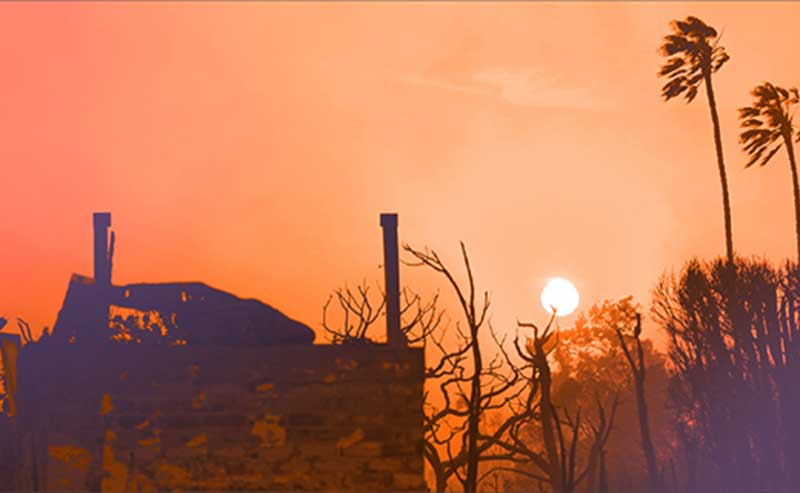
Exploring Toxic Metal Contamination After the Eaton Fire (Photo – Caltech)
One year after the 2025 Los Angeles fires, Caltech researchers continue pushing forward with projects aimed at public health and safety.
By Lori Dajose, Caltech
In the days and weeks after the Eaton and Palisades fires, scientists rapidly mobilized, many while personally affected, to investigate heavy‑metal contamination, monitor air quality, and assess erosion hazards. As John Eiler notes, the tragedy sparked extraordinary goodwill and a rapid scientific response made possible by Caltech’s close‑knit community.
A major concern was lead released from thousands of burned pre‑1978 structures. Francois Tissot’s lab, normally focused on cosmochemistry, redirected its instruments to measure ash and dust from 52 homes. Led by Merritt McDowell and Theo Tacail, the team processed more than 300 samples and found unsafe lead levels as far as seven miles from the burn zone. Their free testing filled a gap left by insurance refusals. The group will resample homes in 2026 and is collaborating with atmospheric scientists to model how smoke‑borne metals disperse during urban firestorms.
Air‑quality researchers in Paul Wennberg’s lab launched PHOENIX, a network of low‑cost, solar‑powered particulate sensors installed across Altadena. Led by Haroula Baliaka and Coleen Roehl, the system revealed mostly “good” air punctuated by short morning spikes, likely from cleanup activity. Data from the ASCENT network also showed lead levels ten times higher than normal, confirming that burned buildings released toxic metals across the region.
Meanwhile, geomorphologist Michael Lamb’s group modeled the fire–flood cycle in the San Gabriel Mountains. Using drone surveys to measure loose post‑fire sediment, the team accurately predicted the massive debris flows triggered by the first major rainstorm—over 677,000 cubic meters. Their work helped guide emergency excavation at the Sierra Madre Dam, which ultimately filled and slightly overtopped but protected nearby neighborhoods. The team is now developing a method to rapidly assess debris‑flow hazards in other fire‑prone mountain ranges.
Ecologically, recovery has been unexpectedly resilient. Entomologist Joe Parker, who has long studied ant colonies in the Angeles National Forest, found that 13 of 15 colonies survived, protected inside Coast Live Oaks adapted to fire. By spring, ant activity had returned and wildflowers were blooming.
Across all these efforts, Caltech researchers, many personally affected, channeled their expertise into urgent, community‑focused science, aiming not only to help Los Angeles recover but to improve responses to future fires.
> This article has been edited for brevity. Read the full version at this link.









Leave a Reply