







SCIENCE CORNER
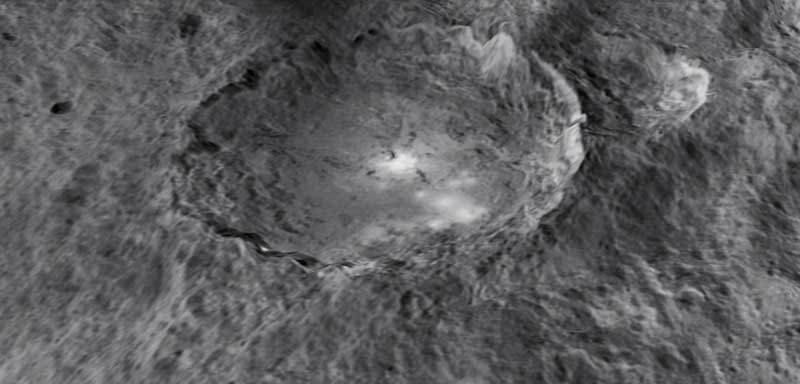
A still image from a video showing a series of animations of dwarf planet Ceres, generated from data from NASA’s Dawn spacecraft (Photo – jpl.nasa.gov).
An ambitious explorer from Earth is gaining the best views ever of dwarf planet Ceres. More than two centuries after its discovery, this erstwhile planet is now being mapped in great detail by Dawn.
By Dr. Marc D. Rayman
The spacecraft is engaged in some of the most intensive observations of its entire mission at Ceres, using its camera and other sensors to scrutinize the alien world with unprecedented clarity and completeness. At an average altitude of 915 miles and traveling at 400 mph, Dawn completes an orbit every 19 hours. The pioneer will be here for more than two months before descending to its final orbit.
The precious pictures and other data have just begun to arrive on Earth, and it is too soon to say anything about the latest findings, but stand by for stunning new discoveries. Actually, you could get pictures about as good as Dawn’s are now with a telescope 217 times the diameter of Hubble Space Telescope. An alternative is to build your own interplanetary spaceship, travel through the depths of space to the only dwarf planet in the inner solar system, and look out the window. Or go to the Ceres image gallery.
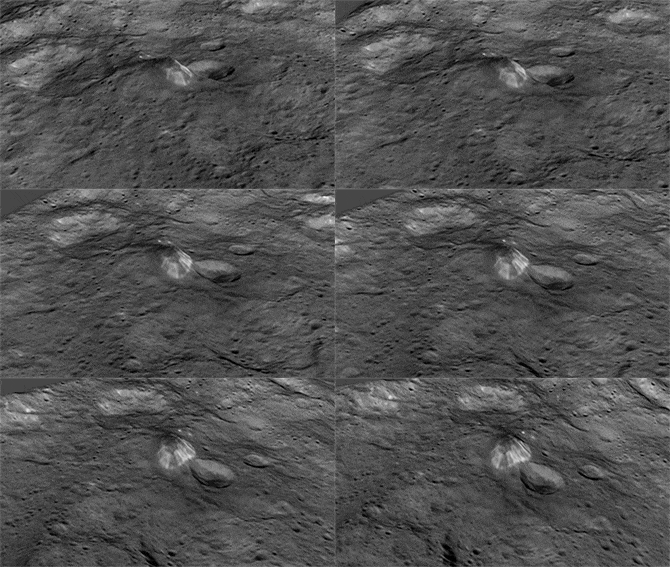
A brief animated clip of Ceres based on Dawn’s observations through the 2nd mapping orbit. This excerpt shows the conical mountain (Photo – NASA/JPL-Caltech/UCLA/MPS/DLR/IDA/LPI).
Dawn has already gained fabulous perspectives on this mysterious world from its first and second mapping orbits. Now at one third the altitude of the mapping campaign that completed in June, its view is three times as sharp. (Exploring the cosmos is so cool!) That also means each picture takes in a correspondingly smaller area, so more pictures are needed now to cover the entire vast and varied landscape. At this height, Dawn’s camera sees a square about 88 miles (140 kilometers) on a side, less than one percent of the more than one million square miles (nearly 2.8 million square kilometers). The orbital parameters were chosen carefully so that as Ceres rotates on its axis every nine hours (one Cerean day), Dawn will be able to photograph nearly all of the surface in a dozen orbital loops.
> Dr. Marc D. Rayman is the Dawn Mission Director and Chief Engineer at JPL. Marc greatly enjoys sharing the thrill of interplanetary adventures with the public.













Leave a Reply