






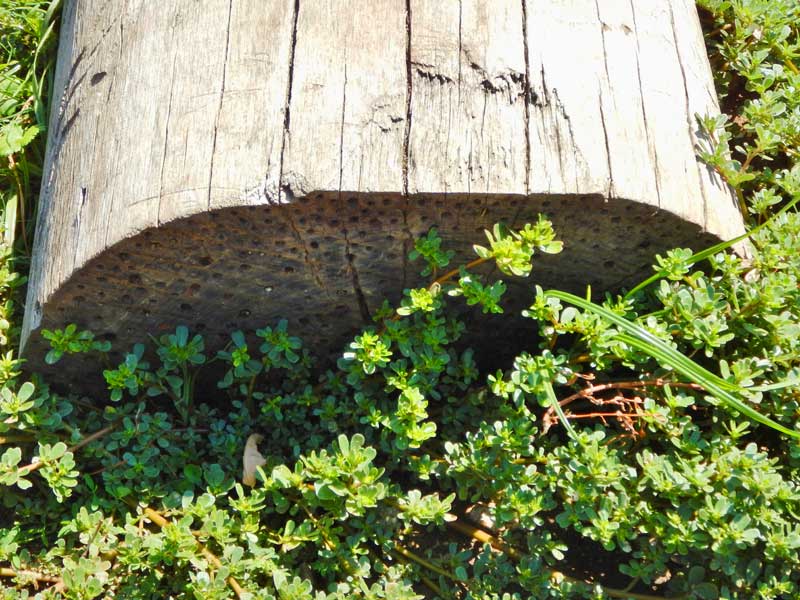
Natural bee hotel (Photo – Jean Sudbury).
Let me tell you ‘bout the birds and the bees and the flowers and the trees…and a thing called Bee Hotels!
By Jean Sudbury
Bee hotels? Yes, bee hotels.
What are they, and why do we need them? Some consider bees to be poisonous pests. On the contrary, bees are the hardest working pollinators in the garden. For centuries, bees have lived and worked in fertile habitat such as forests, groves and farmlands. In California, many species of pollinator bees are losing their homes to urban development. As the pollinators decline, so does garden fertility.
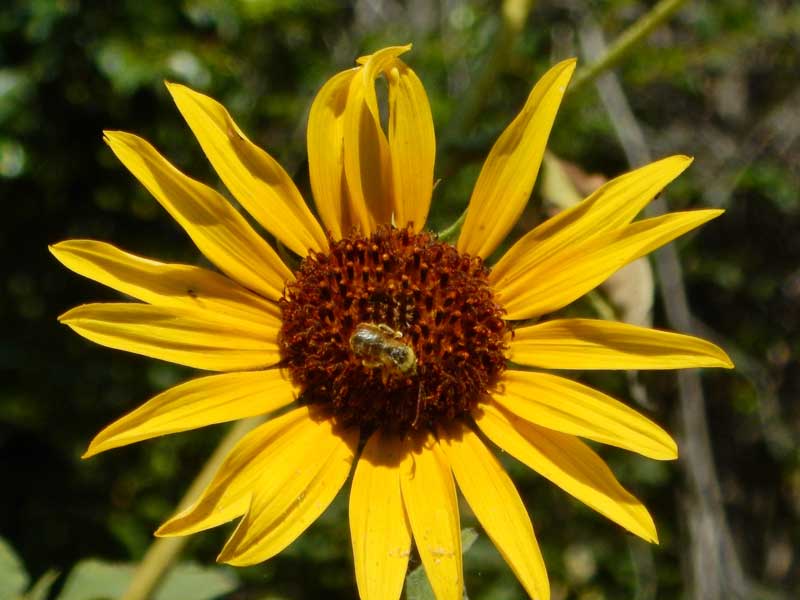
Photo – Jean Sudbury
Fertilization shouldn’t come in a box
If the bee disappeared off the surface of the globe, then man would have only four years of life left. No more bees, no more pollination, no more plants, no more animals, no more man.
~ Albert Einstein
In our urban society, many are of the belief that fertilization comes from a box or a plastic bottle with a spray handle. Having put on a surgical mask, a gardener may spray these elements on the garden once a month or so, or maybe twice a year. On the package, it cautions the user to try not to breathe it, nor let get on the skin. However, they say it is safe to use. Many convenient garden fertilizers, which contain systemic herbicides, are killing our pollinators. Some companies are finally aware of that and are trying to clean up their products. However, residual damage is evident and it is our responsibility to help create new habitat for these remarkable creatures.
In the name of civilization, the civic engineers are destroying the habitat of creatures which help to keep us alive as a species. With that in mind, bee hotels seem eminently feasible and necessary in all urban areas. Apis mellifera, Commercial honey bees, contribute to about half of the pollination of agricultural crops. The wild bees do the remainder of the work. A small percentage of the wild bees share the work of pollinating agricultural crops. The others bees are just as important. The plants they pollinate are consumed by birds and other wildlife. The birds and other wildlife are part of the pollination or fertilization cycle, as well as the bees.
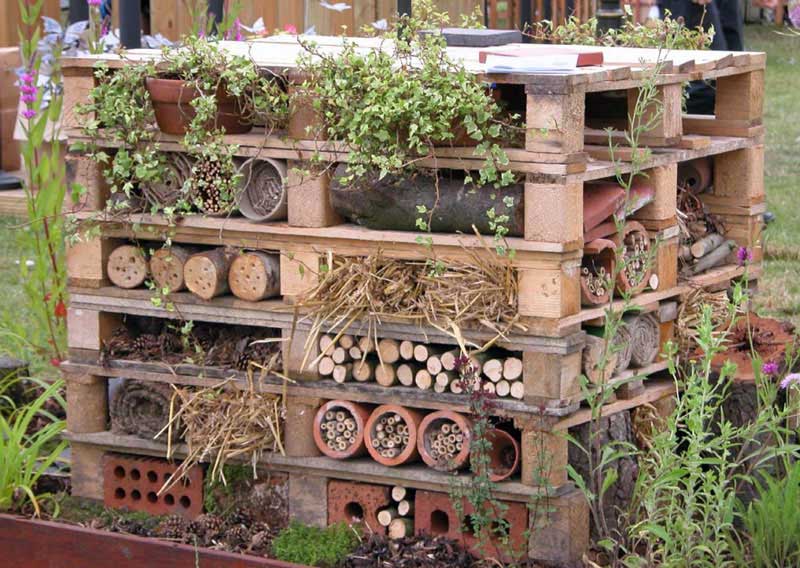
Wildlife trust insect hotel (Photo – Jean Sudbury).
Crescent Farm at The Arboretum
At the Crescent Farm at The Arboretum, bee hotels are popular sites. They house bees and other pollinating insects. The birds use them as perches. Visitors of the garden are intrigued by the colors and the shapes of these oddities. They are constructed from various sizes of bamboo pieces.
Small, drinking straw sized pieces of bamboo are the right size for Mason Bees. Compared to commercial honey bees, they pollinate twice as much, they have no hives and they do not sting. Of all the species of wild bees, Mason bees are the best pollinators.
Bombus Terricoa, or Bumblebees, are valued pollinators. Potatoes, alfalfa, rose family members, such as raspberries, and a variety of wildflowers and other crops are pollinated by bumblebees. They are somewhat clumsy, and fly low to the ground. As they fly, they vibrate. This vibration, or ‘’buzz pollination,’’ shakes out the pollen from grasses and other low growing plants. This vibration helps dislodge pollen that otherwise remain trapped within the anthers of the flowers. Bumblebees forage on a wide variety of plants, although some plants rely upon bumblebees to spread their pollen. Tomatoes and peppers are included in the plants which depend upon bumblebees for pollination.
Bumblebees, honey bees, carpenter bees, cuckoo bees, mason bees, stingless bees, orchid bees, digger bees, and other wild bees, belong to the genus Bombus within the family apidae. Carpenter bees drill perfect circular holes in chopped tree stumps and branches which are lying on the ground. These are their homes. They leave a residue of sawdust on the ground around their work, hence the name, carpenter bees. Carpenter bees and bumblebees are similar in pollination habits, and carpenter bees have black and shiny bodies, whereas the bumblebees are striped.
Mason bees are solitary bees. They like to travel alone, rather than in swarms. They prefer single rooms in their bee hotels.
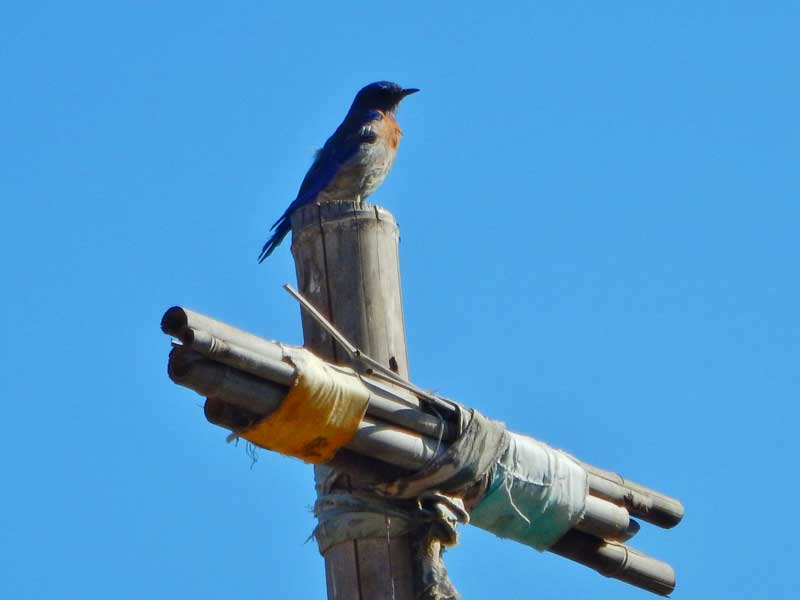
One of the bee hotels at The Crescent Farm. They double as perches for local birds
How to create a bee hotel?
One way to get started is with pieces of cut bamboo.
Take one bamboo pole, about 4 feet high. Tie drinking straw sized pieces of bamboo together, and attach them to one end of the pole horizontally so they are aligned in a criss-cross shape. See photos of bee hotels at The Crescent Farm for visual aid. Wrap them tightly with twine, rags, whatever might be useful. When the pieces have been tightly tied to one end, dig a 6 inch deep hole in the ground and stick the other end in the ground. Securely position the pole with a handful or two of small to medium rocks, sealing it in nicely with soil. Scatter wildflower seedlings in the topsoil around the bamboo poles at ground level and sprinkle lightly with water. Watch for the wildflower seedlings to start emerging. It only takes a few days.
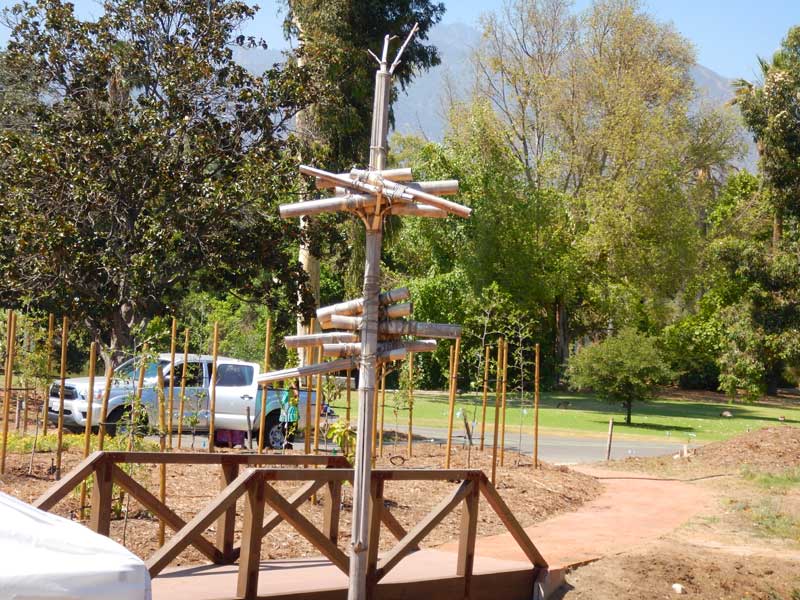
At the Crescent Farm (Photo – Jean Sudbury).
Mason bees and other solitary bees eventually find the openings of the horizontal pieces of bamboo. They crawl in and use them as nests. Then they explore all the possibilities of pollination. Varieties of grasses and wildflowers attract the bees, and once the garden gets going, there is always something abloom.
Fancy bee hotels are being built along highways in Europe. Once we get started with our single pole bee habitats, perhaps the singular structures will eventually be upgraded to European standards.
Let’s be aware of the significance of bees!
> Handmade bee hotels are on display and in use at The Crescent Farm at The Arboretum. Tuesdays and Thursdays are volunteer days at The Crescent Farm from 10:00 a.m. till 4:30 p.m. Visit during those times, and the volunteers and employees at the Crescent Farm will answer any questions.














Now I waited and waited and nobody, not even bees have shown any interest in the subject matter. I don’t hear a hum! This is a sad state of affairs. I can understand the bees because they don’t want the location of their extramarital affairs advertised but the people, I mean the very people that love honey are not sticking to their beliefs. I wish upon those latter ones that do not like plain US honey-producing bees a swarm of African bees! Maybe that’ll change their minds and interests!
Now, Jean-Honey, you see how I come out to your defense?