






GUEST EDITORIAL
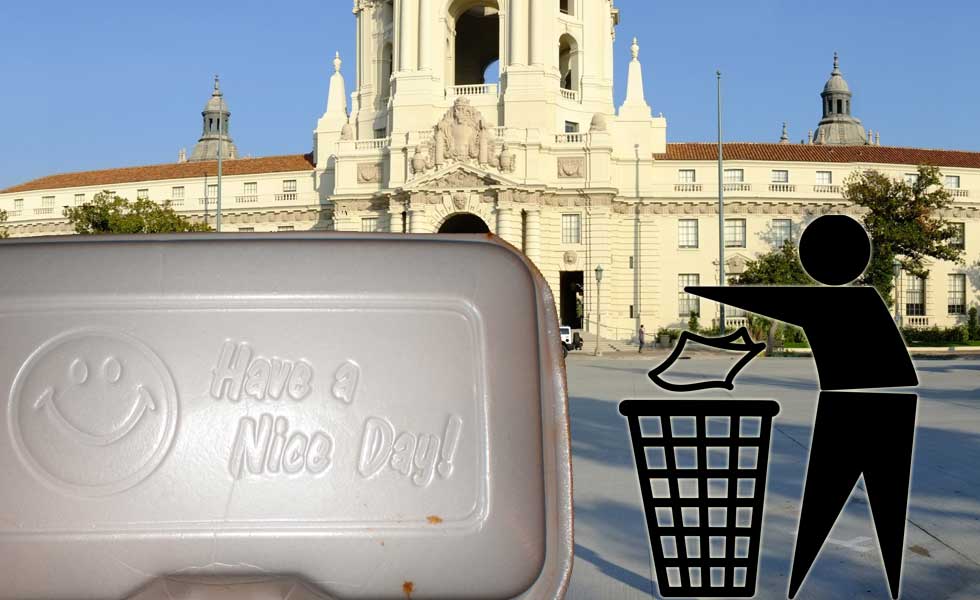
Time to Ban Polystyrene in Pasadena (Photo – Coloradoblvd.net Graphic Department).
There was a popular phrase in a song back in the day: “There’s a kind of hush….” Well that hush has been hanging over a deception perpetrated upon restaurants and the public in Pasadena by DART Container Corporation.
By Morey Wolfson
Who knows for sure whether Styrofoam plates, cups, and clamshells go to the landfill or get recycled? We do know that some of the containers find their way onto our sidewalks, streets, and parks. And we can see it floating down the Arroyo to the LA River, on its way to the Pacific, into the mouths of fish who mistake it for food. Tons of it litter our beaches. But if we put Styrofoam in our blue lid bins in Pasadena, will it get recycled?
“There’s a kind of hush….”
To ensure that our highly-educated population remains confused, or misled, the nation’s largest manufacturer of Styrofoam food and beverage containers (DART Container Corporation) has brought their corporate-wide time-tested “big lie” campaign to our community to help answer the question about Styrofoam and recycling. The sad part is that dozens of unwitting restaurant owners gladly obliged DART to perpetuate the lie. These Styrofoam restaurants said yes when DART’s friendly agents asked them if they would tape shiny deceptive signs on their windows.
In addition, DART sat down with the Styrofoam restaurants and watched them write (over 100) letters to the City using DART’s suggested language. The stock letter contained the standard complaints about running a business, and how the extra cost (we’ll get to that in a minute) they will absorb by eliminating Styrofoam will really hurt their income, etc.
Back to the “big lie”: Fifty-five of the letters to the City said “it makes no sense to ban the foam food and beverage containers when they can be recycled.”
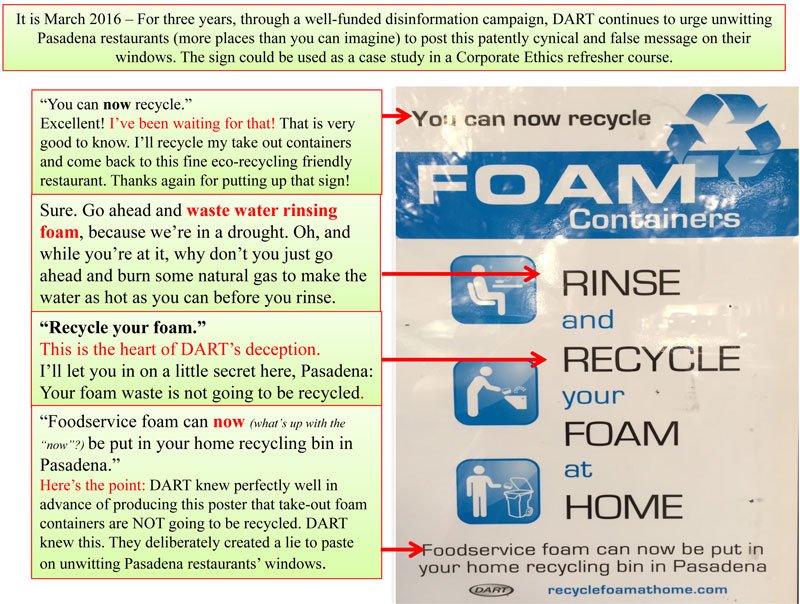
Figure 1
Follow the foam
Okay Pasadena. Just do exactly as instructed by the friendly DART Container Corporation’s sign. Go home with your clamshell container and rinse it off. Put it in a bag of “recyclables” that you toss in the City of Pasadena’s curbside recycling blue bin. The blue bin is picked up by the City, then hauls the “the recyclables” to the Allan Company, located in Baldwin Hills. The City has a sole residential recycling partnership agreement with Allan. Follow the foam food and beverage containers that move down Allan’s conveyor belt. Since the containers are contaminated and since foam has negative economic value, it continues to the end of the conveyor belt to join the other “non-recoverables.” Then follow the foam as it is trucked and dumped at the Scholl Canyon landfill (a few miles past the western edge of Pasadena). There it will rest, essentially for an eternity. That answers the question whether DART’s restaurant foam will get recycled.
We are off to a good start, but we have more work to do
In 2011, in a unanimous vote, the Pasadena City Council made environmentally-minded citizens proud. Pasadena joined many other California cities by banning single-use plastic bags. Sure, there were complaints, and people kept forgetting to grab their canvas bags when they went to the market, but we are now much better off now, because our Councilmembers exercised their political will to act. Before the ban, volunteers at the annual Arroyo trash pick-up would always encounter hundreds of plastic bags. No more. But the volunteers can always count on confronting an inordinate amount of Styrofoam take out containers.
For sound environmental reasons, and encountering virtually no economic costs or actual hardships, 95 California jurisdictions have enacted ordinances that ban foam food and beverage containers. Now it is time for a similar green initiative in Pasadena. Pasadena is on a critical path to being jurisdiction number 96, and that will happen most effectively if “the kind of hush” is confronted.
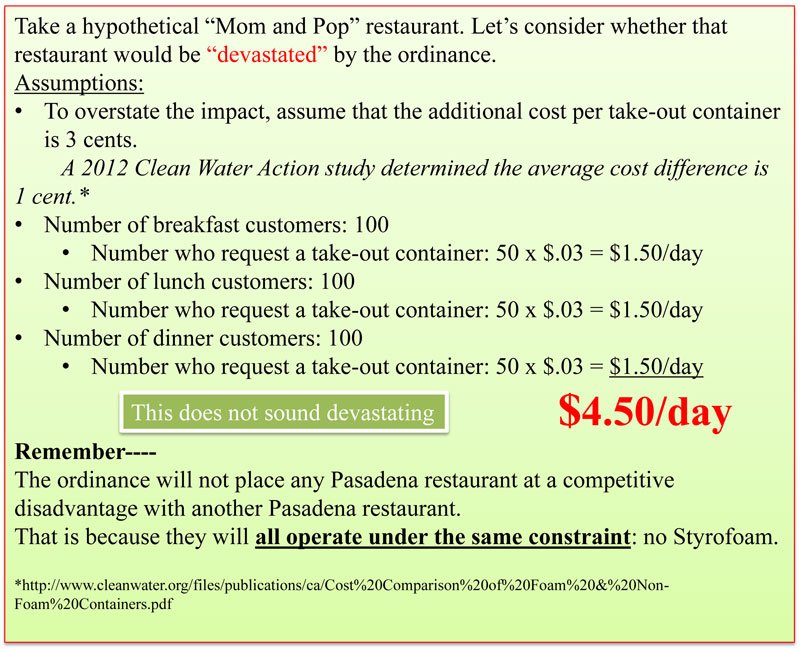
Hypothetical restaurant container cost difference
The process
The Department of Public Works (DPW) is the lead agency for the implementation of the City’s Zero Waste Pasadena (ZWP) policy, approved by a unanimous City Council vote on October 22, 2014. That policy listed enacting a ban on Styrofoam take-out containers as the first of 19 ZWP priorities to be implemented.
The Council has a procedure where they vet public policy issues through its Committee structure. On the Styrofoam container ban topic, it is the Municipal Services Committee (MSC) that has oversight over the DPW, and the City’s ZWP direction. The MSC reports to the Council, either recommending or opposing Council action. Or they can further delay action.
After two years of research and public input, a draft Styrofoam ordinance was presented at the December 8, 2015 MSC meeting, along with a Staff Agenda Report that recommended moving forward with an ordinance. DPW’s Environmental Manager, Gabriel Silva, helps lead implementation of the ZWP policy. He is the City’s subject matter expert on Styrofoam take out containers, and has long known the answer to whether they get recycled. He also answers questions regarding waste management, composting, food waste, recycling centers, landfills, tipping fees, the Department’s services, etc. Mr. Silva is the lead staff member tasked with preparing a Department policy document called a Staff Report, which must first be approved to by the DPW Director Ara Maloyan and the Interim City Manager Steve Mermell before it is presented to the MSC.
Back to the December 8 MSC meeting. Mayor Tornek was out of town on that date. It was at the height of the debate on whether to increase the minimum wage. Both the MSC Chair Councilmember Margaret McAustin and Councilmember Andy Wilson delayed action on the ordinance item, directing DPW Staff to conduct additional research.
It was recently brought to the attention of the Environmental Advisory Commission that a stack of letters from restaurants opposing a ban had been filed with the City Council. The stack contained 126 letters, with perhaps over a dozen signed by multiple employees at a single restaurant.
The restaurants’ letters date back to May 2015. It is clear that the restaurants were prompted to write the letters by either DART or the California Restaurant Association, or both. Many of the letters were on the same lined paper, and there is a clear pattern that exact same words were used in their phrases. In many of the restaurants’ letters, they proudly stated that they encourage their patrons to rinse the Styrofoam when they get home, put it in the blue bin, and the City will be sure that it gets recycled. (See Figure 1.)
DART has abused unwitting Styrofoam restaurants in Pasadena. Their deception reminds me of when cigarette companies paid doctors to testify to Congress that their product was perfectly safe. Pasadena restaurants have been duped by their foam supplier into believing that Styrofoam take-out containers are getting recycled or can be recycled. What may even be more egregious is that their patrons read falsehoods on the poster, and actually believe that the foam that they take home will be recycled.
To keep market share, DART proceeded with their lie, duping unwitting restaurants to display their lie in the restaurants. Residents and visitors patronize these restaurants and think – ‘Wow! I thought Styrofoam was a problem in the environment. But everything is cool with foam. The “City’s recycling program” (as the restaurants call it) is taking care of any concerns with Styrofoam.’ Meanwhile, while this happens, the City conducts research, but keeps a low profile about DART’s lie. It will be not be long before there will be wide public knowledge that Pasadena’s Styrofoam restaurants were fed lies by DART.
The point is: DART knew full well that the Styrofoam will not be recycled, but they went ahead with their deception, thinking that “a kind of hush” will win the day- and avoid an ordinance that would cut into their sales.

CWA Polystyrene Foam Cost Comparison
A ban will not hurt Styrofoam restaurants, and it will help the environment
When one considers the cost structure of a typical small restaurant, it is obvious where the big ticket items reside: food and beverage costs, labor, administration, rent, debt service, utilities, profit, maintenance and repairs, marketing, insurance, etc. A restaurant owner has to go far down the list of costs before they have to seriously worry about the difference in the cost of environmentally-responsible take-out containers when compared to Styrofoam. Everyone has a natural instinct to keep their costs down, but let’s be honest. Three cents, even when it adds up, is not a lot of money.
The ordinance not only “does the right thing for the environment” but will add not more than an average of three cents per container to the cost of those restaurants that currently dispense Styrofoam. For example, if a restaurant hands out 150 take out containers a day, the additional cost would only add up to $4.50/day. Restaurants will be given a year to transition their purchases away from Styrofoam. They will adjust to paying slightly higher container costs that will put them on par with their more environmentally-responsible competitors. And the City will have cleaner streets, sidewalks, parks, storm drainage infrastructure, and waterways. The marine life in the Pacific will thank us, as will the visitors to the beaches.
The positive flight path
Despite DART’s campaign and the lack of research on the matter by the Styrofoam restaurants, I think that we have reason to be cautiously optimistic. The positive flight path started when the City Council passed the plastic bag ban by a unanimous vote in 2011. The City Council passed the ZWP by a unanimous vote in 2014. A ban on Styrofoam take-out containers is the number one priority on a list of nineteen items to be accomplished in the ZWP. The DPW has carefully drafted a well-balanced ordinance. Pasadena’s brand as a “Green City” will be affirmed. We will be California jurisdiction number 96 to enact common sense Styrofoam regulation, and the first in the San Gabriel Valley.
We have three intelligent and highly civic-minded members who serve on the MSC – Councilmember Margaret McAustin, Councilmember Wilson, and Mayor Tornek. The process would be greatly improved if these leaders received messages and testimony from residents urging them to affirmatively move the ordinance to the City Council. Our civic leaders should hear from their constituents that the green community in Pasadena cannot imagine a loss, or further delay, on this ordinance. We need to avoid a situation where either the MSC or the Council votes the ordinance down.

Illustrative restaurant cost structure
The MSC has set a meeting target date of Tuesday, April 26 to bring the ordinance back to their oversight. Please plan to attend the meeting at the Council Chambers in City Hall at 4:00 p.m. Public comment is encouraged, with statements limited to three minutes. If you cannot attend the meeting, please email the MSC members.
This meeting is right around the corner. Does our current pace of public education, and engagement with citizens and elected officials give us confidence that we will win?
In my mind, it is nearly a foregone conclusion that our elected officials will do the right thing. But public opinion is needed to eliminate the “kind of hush.” Citizens need to reinforce the need for the City Council to stand up to DART’s deception.
Let’s make this happen.
Morey Wolfson is a member of the Pasadena Environmental Advisory Commission.










Leave a Reply