








Editor’s note: Today we start a new Health Corner for our readers. We hope it will be helpful and yet informative to each and every one of you. To your health!
HEALTH TALK

Aloe Vera (Photo – irinapulatova.com).
Aloe gel and juice are obtained from the leaves of Aloe vera plant, native to the mountains of tropical Africa.
By H. S. Nemr
Source and chemical components
The juice mainly contains aloe-emodin anthrone, aloin A and B (also referred to as barbaloin and isobarbaloin). These compounds are anthraquinone glycoside derivatives. The gel mainly contains water, organic acids, vitamins, and the polysaccharides: acemannan and glucomannan.
Actions
When taken orally, aloin is cleaved by intestinal bacteria to produce aloe-emodin, a metabolite that irritates the large intestines and stimulates colonic motility. This produces a cathartic effect that usually occurs 8 to 12 hours after ingestion. When used externally, aloe reduces inflammation possibly by blocking the production of thromboxane A2 and inhibiting the oxidation of arachidonic acid. Aloe’s antipruritic effect may result from the blockade of the conversion of histidine to histamine as a result of the inhibition of histidine decarboxylase. In vitro and murine studies suggest that aloe emodin may hold some promise as a useful entity for treating neuroectodermal tumors.
Therapeutic uses/Reported folk uses
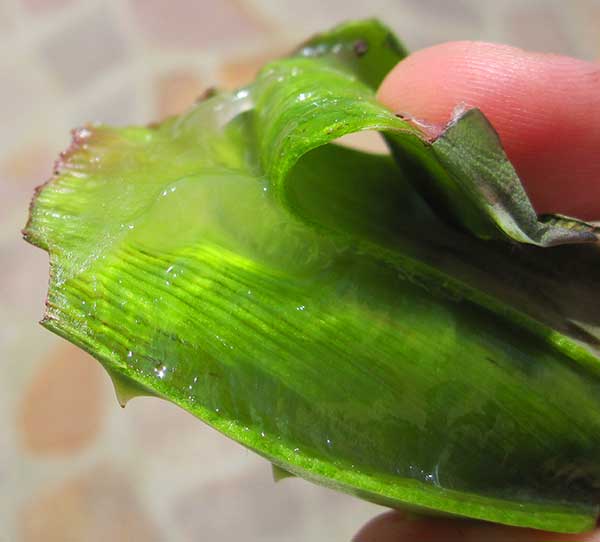
Aloe Vera gel juice extract (Photyo – Pava, wikimedia.com).
Aloe is commonly used topically for the management of frostbites, minor burns, and dermal abrasions. It is also used as an emollient. No medical evidence supports the internal use of aloe latex or juice.
Dosage
Aloe gel or cream can be applied liberally as needed for burns, skin irritation, and pruritis.
Adverse reactions
GI: intestinal spasm, damage to the intestinal mucosa
Genitourinary: kidney damage, red discoloration of urine.
Hematological: accumulation of blood in the pelvic region
Interactions and Precautions
The effect of thaizides, loop diuretics, cardiac glycosides, and antiarrhythmics is potentiated if aloe is used orally. The internal use of Aloe should be avoided in general. Topical application is considered safe.
H.S. Nemr is a graduate of BAU pharmacy school. He is currently a medication safety officer at Johns Hopkins Aramco Healthcare system.
References
1) Professional’s Handbook of Complementary Alternative Medicines, Springhouse, 2nd edition.
2) University of Maryland Medical Center, Complementary and Alternative Medicine Index.
3) The International Aloe Science Council, www.iasc.org.
4) Protein kinase C involvement in aloe-emodin and emodin induced apoptosis in lung carcinoma cell (Pecere et al., 2000).













Leave a Reply