






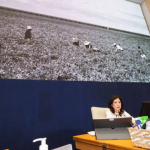


Alex Johnson addressing the DIVE group. (L-R) Sheldon Yu; Lisardo Duran Jr.; Clarisa Torres; Hanna Kashchei; Christopher Lam; and Myia Gilmore (Photo – Lance Hayashida)
After seven years in the U.S. Navy, Alex Johnson was ready to pick up his education where he had left off.
By Judy Hill, Caltech
Johnson, who says he was a “mediocre” student at community college before enlisting in the Navy, felt motivated and ready to focus. He earned his associate’s and Bachelor of Science degrees at Skagit Valley College and Western Washington University. Then, with encouragement from his advisor, Johnson found his way to Caltech.
“I had no plan to follow this path,” says Johnson, “but there were a lot of people along the way who were really important mentors to me.”
Johnson, now pursuing a doctorate in bioengineering, knew that not all veterans are so fortunate in finding their way in academia. So, with his Caltech advisor—Richard Murray, Professor of Control and Dynamical Systems and Bioengineering, Johnson began to envision a program that could give veterans currently enrolled in community college or university “a leg up and a little bit of a boost to help them understand what it really takes to build a career in STEM.”
Two years of discussion and planning with Murray and Ken Hargreaves, Caltech’s associate vice president for civic engagement and external affairs (and himself a Navy veteran), culminated this year in the launch of the Diversification through Veteran Education program, or DIVE.
DIVE is a 10-week summer research program that focuses on synthetic biology and bioengineering, and aims to equip its participants with the skills they need for both academic and research settings.
The six students (five undergraduates and one recent graduate) who comprise this summer’s initial DIVE cohort came to the program with varying degrees of experience in biology: Their majors include computer science, chemistry, and math. They ran through what Johnson calls “a molecular biology boot camp,” during which they learned basic lab and experimental skills from Caltech graduate students.
It can be a challenge for students without a biology background to master standard lab practices, says Zoila Jurado, a Caltech postdoc who heads up the curricular side of the program. “Pipetting, for example, is such a basic skill,” she says, “but you still have to learn it and figure out how it works for you. And, as a biologist, you use a pipette every day, so you do need to do it properly.”
“I’m learning a lot,” says Christopher Lam, a sophomore at Pasadena City College, who spent five years in the U.S. Marine Corps and is taking a math-heavy course load at PCC. “I’m not a wet-lab scientist, but I think the skills I’ve developed here will help me if I pursue a degree in molecular cell biology or biochemistry. And if I go into biophysics, I still might have to do some wet-lab science and protocols.”
The summer experience also includes an independent project component. In groups, they have built DNA constructs, created computer models of biological systems, tested their systems under different environmental conditions, and, finally, presented their findings and conclusions.
Murray’s network of industry connections allowed Johnson to organize field trips for the DIVE students to biotech companies in the LA area. Johnson says this component is crucial because veterans returning to school tend to have a highly purpose-driven approach to their education. “They say, ‘Why am I doing this? What can I actually do with this in the real world?’ We have to give them real-world examples,” Johnson says.
Clarisa Torres, a student at Northwest Vista College in San Antonio, Texas, and a veteran of the U.S. Air Force, says the DIVE experience was eye-opening. “If I hadn’t had a chance to see it with my own eyes, I probably wouldn’t have thought I could belong in the field of bioengineering or pursue it as a career,” Torres says. “But now that I’ve visited some biotech companies, I realize that the things we’re doing here in the lab are very translatable to the workforce. Their benches are pretty similar to ours.”
This article has been edited for brevity and clarity. You can read the full version at this link.










Leave a Reply