







GUEST OPINION
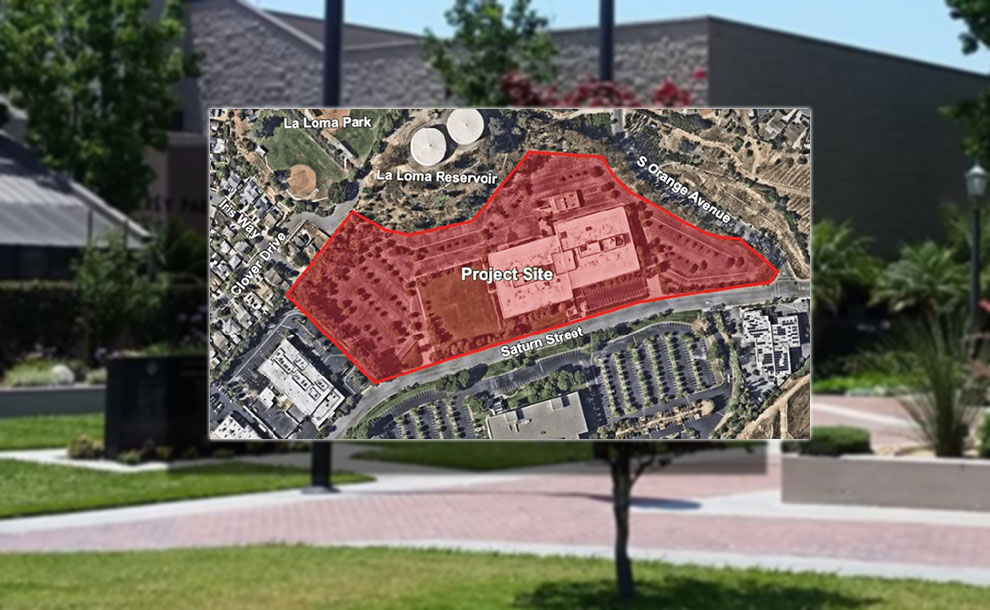
(Map- City of Monterey Park)
The Monterey Park City Council will vote on a proposal for a 247,000-square-foot data center at 1977 Saturn Avenue. The project includes 24 diesel generators, a new Edison substation, and demolition of existing buildings.
By Je-Show Yang
The project lists an unmitigated electricity demand of 434 million kWh per year. That’s 1.7 times the city’s total residential use, equivalent to powering 40,000 homes, even though Monterey Park has only ~20,000 households. This is an unprecedented new load on the city’s grid.
The Council is being asked to approve the project under a Mitigated Negative Declaration (MND), rather than require a full Environmental Impact Report (EIR). An MND is a procedural shortcut that leaves residents exposed to risks a full EIR would identify and address.
What is an MND?
Under California law, cities must review environmental impacts before approving major projects. An MND assumes all impacts can be reduced to “less than significant” through mitigation. An EIR is required when there is substantial evidence of potentially significant impacts.
For a project with 24 generators, a new substation, and major demolition, relying on an MND instead of an EIR is inadequate. Residents deserve the fuller disclosure and alternatives analysis only an EIR provides.
Air Quality Risks
Diesel generators emit pollutants that affect respiratory health. City documents say the generators will run only during outages. In reality, EPA rules allow 50 hours per year for testing, and SCAQMD permits up to 200 hours for emergency operation plus routine maintenance. Industry practice also includes weekly inspections and monthly tests.
Residents deserve clear answers on:
- How often these generators will run,
- How long each test lasts, and
- What air-quality monitoring will be required.
Noise Issues
The City Municipal Code exempts noise from actual emergencies, but routine testing is not exempt. That means generator tests and rooftop equipment must comply with noise limits.
Residents need:
- expected decibel levels at nearby homes,
- nighttime noise projections, and
- enforceable mitigation measures.
Similar data centers produce persistent low-frequency hum that travels long distances. The City should require a study that models nighttime noise and low-frequency impacts before any approval.
Public Benefits
The applicant offers a pocket park and a $200,000 trail extension deposit. These are modest benefits for a project of this scale. Maintenance funding and a community design process should be required. And realistically, few families will want to spend time in a park next to a 24-generator industrial facility.
Fiscal claims
The staff report projects $6.5 million during construction and $5 million in recurring revenue. No breakdown is provided. Residents should know how those numbers were calculated and whether they account for infrastructure strain or public-health costs.
Utilities respond to large new loads with costly upgrades. CPUC recently approved an “exceptional energization” agreement for a large data center, acknowledging that big loads can require special transmission work—and may shift costs onto ratepayers.
Before approving this project, the City must disclose:
- who pays for required electrical upgrades, and
- whether local ratepayers could face higher bills.
Is This the Best Use of the Site?
The lot is underused, but that doesn’t mean a data center is the best option. Once built, the facility would operate 24/7 but create only 26 permanent jobs. Alternatives—housing, mixed-use development, community space—could provide lasting benefits without pollution and noise.
Proximity to Homes
Families living next to the site will bear the direct impacts. Placing a 24-generator data center beside La Loma Park and residential blocks is incompatible with neighborhood health and quality of life.
Real-world examples show the risks. In Georgia, a homeowner lost safe drinking water and water pressure after a data center was built nearby, while others documented runoff and heavy water use during heat waves. Data centers can be loud, thirsty neighbors, and the impacts fall on the people living closest.
Call to Action
This project would reshape a large site and introduce industrial operations next to homes and a public park. Residents must insist on a full Environmental Impact Report and stronger conditions before approval.
The Council hearing is scheduled for December 3. Attend, speak, and submit written comments. Raise detailed questions about air quality, noise, public benefits, fiscal transparency, grid impacts, and the lack of alternatives. The Council needs to hear from the people most affected.
Je‑Show Yang is a community health advocate and program manager who works in a nonprofit in Alhambra on environmental justice issues.

Proposed project site (Photo- City of Monterey Park)












Thank you for this article! This is exactly what Monterey Park residents need to stand up for their rights.