







SCIENCE CORNER

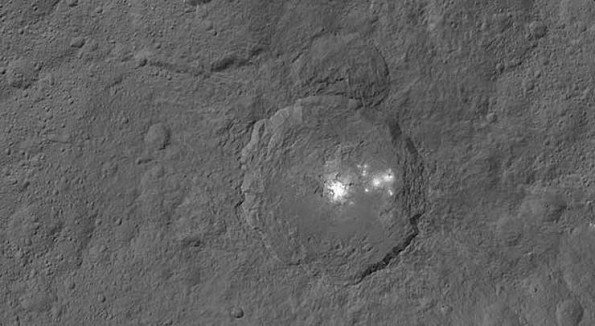
An artist’s impression of the dwarf planet Ceres (Photo – NASA / JPL-Caltech).
Ceres shows signs of an active past rather than that of a static chunk of inert material passing the eons with little notice.
By Dr. Marc D. Rayman
Some areas are less densely cratered than others, suggesting that there are geological processes that erase the craters. Indeed, some regions look as if something has flowed over them, as if perhaps there was mud or slush on the surface.
In addition to evidence of aging and renewal, some powerful internal forces have uplifted mountains. One particularly striking structure is a steep cone that juts three miles (five kilometers) high in an otherwise relatively smooth area, looking to an untrained (but transfixed) eye like a volcanic cone, a familiar sight on your home planet (or, at least, on mine). No other isolated, prominent protuberance has been spotted on Ceres.
It is too soon for scientists to understand the intriguing geology of this ancient world, but the prolific adventurer is providing them with the information they will use. The bounty from this second mapping phase includes more than 1,600 pictures covering essentially all of Ceres, well over five million spectra in visible and infrared wavelengths and hundreds of hours of gravity measurements.
The spacecraft has performed its ambitious assignments quite admirably. Only a few deviations from the very elaborate plans occurred. On June 15 and 27, during the fourth and eighth flights over the dayside, the computer in the combination visible and infrared mapping spectrometer (VIR) detected an unexpected condition, and it stopped collecting data. When the spacecraft’s main computer recognized the situation, it instructed VIR to close its protective cover and then power down. The unit dutifully did so. Also on June 27, about three hours before VIR’s interruption, the camera’s computer experienced something similar.
Most of the time that Dawn points its sensors at Ceres, it simultaneously broadcasts through one of its auxiliary radio antennas, casting a very wide but faint signal in the general direction of Earth. (As Dawn progresses in its orbit, the direction to Earth changes, but the spacecraft is equipped with three of these auxiliary antennas, each pointing in a different direction, and mission controllers program it to switch antennas as needed.) The operations team observed what had occurred in each case and recognized there was no need to take immediate action. The instruments were safe and Dawn continued to carry out all of its other tasks.
When Dawn subsequently flew to the nightside of Ceres and pointed its main antenna to Earth, it transmitted much more detailed telemetry. As engineers and scientists continue their careful investigations, they recognize that in many ways, these events appear very similar to ones that have occurred at other times in the mission.
Take a flight over Dwarf Planet Ceres:
Dr. Marc D. Rayman is the Dawn Mission Director and Chief Engineer at JPL. Marc greatly enjoys sharing the thrill of interplanetary adventures with the public.












Leave a Reply