






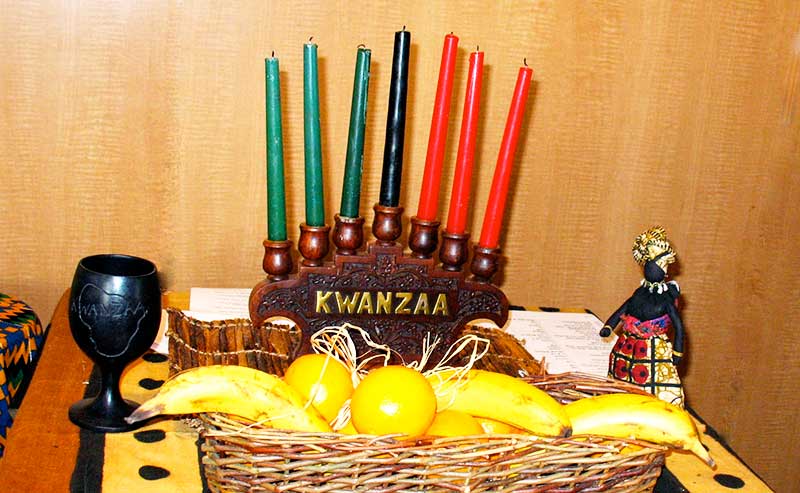
Kwanzaa Celebration (Photo – Black Hour)
Heri za Kwanzaa! Happy Kwanzaa!
By News Desk
Join a joyous Kwanzaa celebration full of music, storytelling and youth presentations, in partnership with the Pasadena Alumnae Chapter of Delta Sigma Theta Sorority, Inc. Celebrate heritage and tradition with family, friends and the whole community!
Kwanzaa celebration
Kwanzaa celebration is not a festival originating in any of the 55 African countries, nor is it an “African” Christmas celebration. It’s an African-Americans celebration of life from December 26th to January 1st.
Dr. Maulana Karenga introduced the festival in 1966 to the United States as a ritual to welcome the first harvests to the home. Dr. Karenga created this festival for Afro-Americans as a response to the commercialism of Christmas. In fact, one might say that Kwanzaa has similarities with Thanksgiving in the United States and Canada or the Yam Festival in Ghana and Nigeria. The word “kwanza” is a KiSwahili (Kenya, Uganda, Tanzania) word meaning “first.”
Values and Principles
Five common sets of values are central to the activities of the week: ingathering, reverence, commemoration, recommitment, and celebration. The seven principles (nguzo saba) of Kwanzaa utilize Kiswahili words: unity (umoja), self-determination (kujichagulia), collective work and responsibility (ujima), cooperative economics (ujamaa), purpose (nia), creativity (kuumba), and faith (imani). Each of the seven candles signify the principles. Like the Jewish Hannakah, candles are used to represent concepts of the holiday.
Symbols
The symbols of Kwanzaa includes crops (mzao) which represents the historical roots of African-Americans in agriculture and also the reward for collective labor. The mat (mkeka) lays the foundation for self- actualization. The candle holder (kinara) reminds believers in the ancestral origins in one of 55 African countries. Corn/maize (muhindi) signifies children and the hope associated in the younger generation. Gifts (Zawadi) represent commitments of the parents for the children. The unity cup (Kkimbe cha Umoja) is used to pour libations to the ancestors. Finally, the seven candles (mishumaa saba) remind participants of the severl pinciples and the colors in flags of African liberation movements — 3 red, 1 black, and 3 green.
Exchanging of gifts
On December 31st, participants celebrate with a banquet of food often cuisine from various African countries. Participants greet one another with “Habari gani” which is Kiswahili for “how are you/ how’s the news with you?” and exchange gifts.
> Visit the official Kwanzaa website.*
36th Annual Kwanzaa Celebration
Friday, Dec. 27
11:00 am
Location
Jefferson Branch Library
1500 E Villa St.
Pasadena, CA 91106
*Source: Akwansosem African Studies Program – Outreach, University of Wisconsin-Madison Vol. III, No. 2 – March, 1990.











Leave a Reply